Baba Nyonya Peranakans informs readers with the History, Culture, Food, and authentic Recipes of this Southeast Asian culture of Malaysia and Singapore.
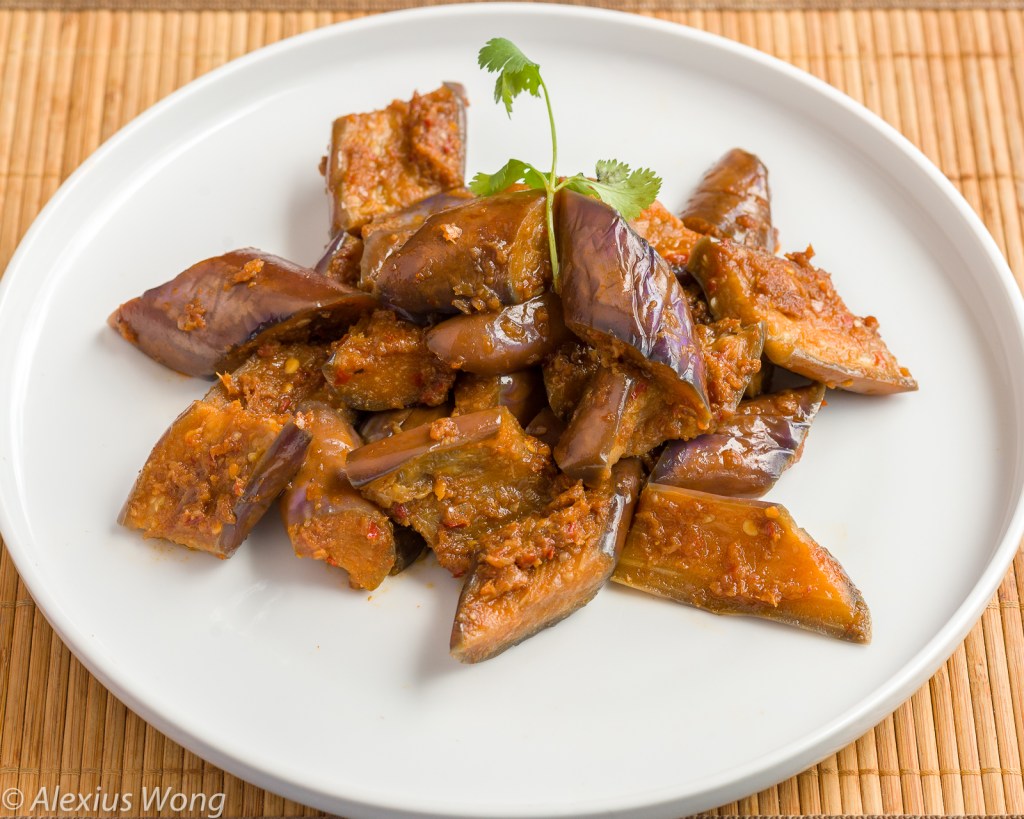
Here, we see the Malay influence in the pairing of this mild vegetable with a spice paste that consists of fresh and dried chili peppers, shallots, garlic, and the ubiquitous pungent Belacan (shrimp paste). The use of the latter ingredient along with dried shrimp takes this dish to another level with a huge amount of umami savoriness added to this bland vegetable. However, the treatment of the eggplant is very Chinese in which it is not overcooked, and the pieces maintain their integrity while being infused with spiciness and flavor. Invariably, I always looked forward to my grandmother making this wonderful dish that did not need to convince her grandchildren to enjoy this vegetable due to the dish’s flavors.
When buying eggplant, choose the dark ones with a firm flesh; try to find the long Asian variety and not the bulbous Western one, which can have bitterness to it. Make sure to add only increments of ¼ cup of water when cooking so that the eggplant is steamed and not boiled, hence retaining its shape and texture. Once you get to taste this flavor-packed dish, you will understand why it was my family’s preferred way of eating eggplant, a preference that carries on to this day.
Recipe from Edible Memories e-cookbook
Serves 4
Preparation time: 15 minutes
Cooking time: 15 minutes
5 dried chili boh or Kashmiri peppers, or chile puya, stemmed, seeded & soaked (or 1 tablespoon dried chili paste)
2 tablespoons dried shrimp, soaked in water for 10 minutes and drained
3 medium/2 large Asian eggplants, stem removed, halved lengthwise & cut diagonally into 2-inch (5 cm) wide pieces (400 gm)
4 – 5 Finger Hot red chili peppers, stemmed and seeded (or 2 tablespoons paste)
5 small/50 grams shallots, peeled and roughly chopped
3 cloves garlic, peeled and roughly chopped
1 inch (2½ cm) Belacan/shrimp paste (½ teaspoon paste)
¾ cup water
½ teaspoon sugar
½ teaspoon salt
Soak the dried chili boh peppers in hot water. Do the same for the dried shrimp in another bowl.
Meanwhile, prep the eggplant, red chili peppers, shallots, and garlic.
In a food processor, add the drained dried shrimp and chop until fine. Remove and reserve.
To the processor, add the drained dried red chili peppers and process until fine. Then add the red chilies, shallots, garlic, and Belacan, and process into a very smooth mixture. Remove and reserve.
In a pan on medium-high flame, add 4 tablespoons oil. Fry the processed mixture and dried shrimp for 3 minutes or until aromatic.
Add the eggplant and mix for around 1 minute. Add only ¼ cup water, ½ teaspoon sugar and ½ teaspoon salt. Mix well, cover, and lower heat to medium. Cook for 8 to 10 minutes by stirring occasionally and adding an additional ¼ cup water each time the sauce dries up, until eggplant is fully cooked but not too soft.
When the eggplant is cooked, the sauce should have very little liquid left but not completely dry. Taste and adjust seasoning. Serve immediately.
The hardcopy and e-book of The Baba Nyonya Peranakans book (1st image) and Edible Memories e-cookbook (2nd image) are available – more information on the Homepage.
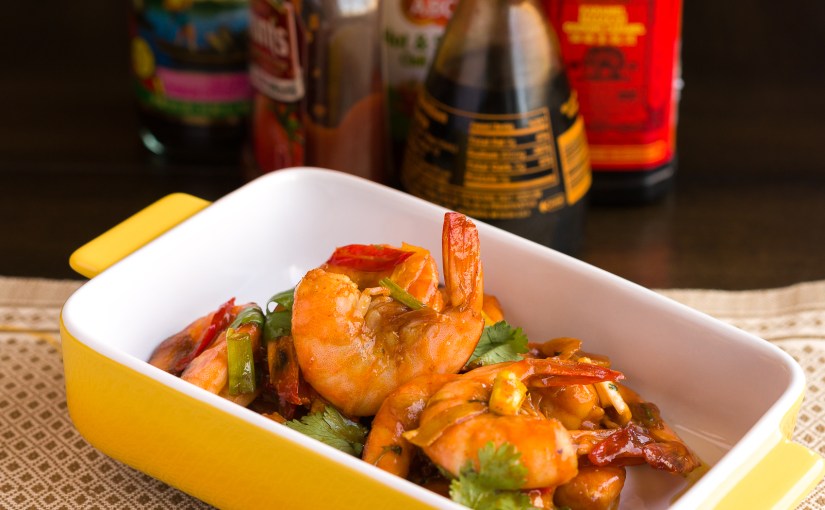
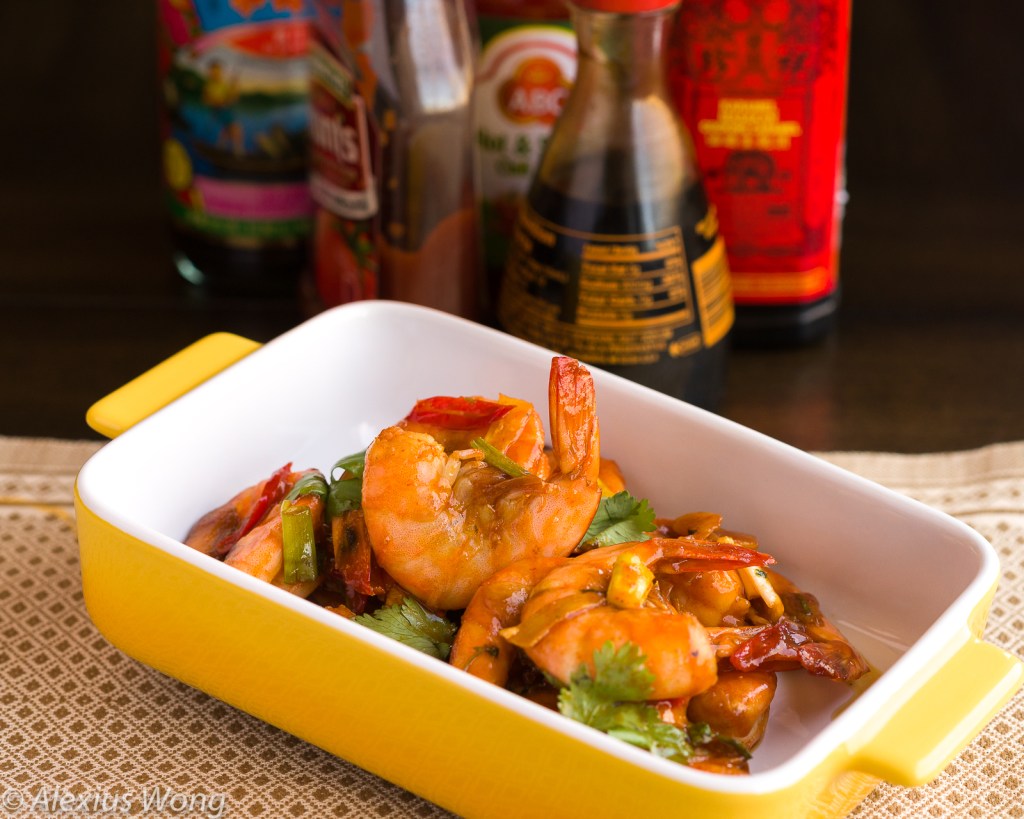
Usually, the word “asam” denotes the use of tamarind in Nyonya cooking as found in many of its dishes. Here, however, we have a dish that defies the use of that local ingredient. But the dish’s sour element comes from the different sauces of tomato ketchup, sweet chili sauce, and white vinegar, seasonings borrowed from English colonial times.
In addition the above sauce ingredients, this relatively easy dish packs a lot of flavor from the ginger root, garlic, oyster sauce, white pepper, and dark soy sauce, all contributing to a complex sauce that will make you want to savor every drop coating the shrimp shell before peeling it. In addition, the young celery leaves and spring onions bring in more herbal aromatics and texture to the dish. To avoid overcooking the shrimp, mix all the sauce ingredients in a bowl, and pour it into the pan once the shrimp is no more pink on the outside. If you cannot find young celery, you can substitute it with celery leaves or cilantro that are chopped fine.
After cooking this, don’t be surprised to find yourself licking every drop of this fantastic sauce.
Recipe from Edible Memories e-cookbook
400 gm medium to large shrimp, heads off, with shells on
Vegetable oil
4 cloves garlic, peeled & cut into thin long wide slivers
2 Finger Hot red chili pepper, stems and seeds removed & sliced fine
Sauce ingredients:
2 tablespoons tomato ketchup
2 tablespoons sweet chili sauce
2 tablespoons oyster sauce
¼ teaspoon white pepper
½ teaspoon dark soy sauce
½ teaspoon salt
1 teaspoon sugar
1 tablespoon rice or white vinegar
1-2 stalk young celery leaves (Cantonese: kahn choy), sliced 1-inch (2 ½ cm) long
1-2 stalk spring onion, cut 1-inch (2½ cm) long
If shrimps are not deveined, follow these steps:
Holding the shrimp in one hand, hold a small serrated knife in the other hand, and start at the top of the first shell after the head. Cut into the shell and into the flesh all the way until before the last segment before the tail, deep enough to expose the vein – do not go deeper than the vein. Remove the vein and dip it with the fingers in a bowl of water to release it.
In a wok or pan on medium-high heat, add 4 tablespoons oil, and fry garlic, ginger and chili for 1 minute or less until aromatic and slightly golden brown. Add the shrimp, and stir them for 1 minute or until they appear just cooked on the exterior. When cooked, lower flame to medium-low.
In a bowl, mix the ketchup, chili sauce, oyster sauce, white pepper, dark soy sauce, ½ teaspoon salt, 1 teaspoon sugar, and 1 tablespoon vinegar. Add sauce to pan. Bring sauce to a simmer and let it reduce until thick. Taste and adjust seasoning. Stir in green onion and celery leaves for 1 minute. Serve immediately.
The hardcopy and e-book of The Baba Nyonya Peranakans book (1st image) and Edible Memories e-cookbook (2nd image) are available – more information on the Homepage.
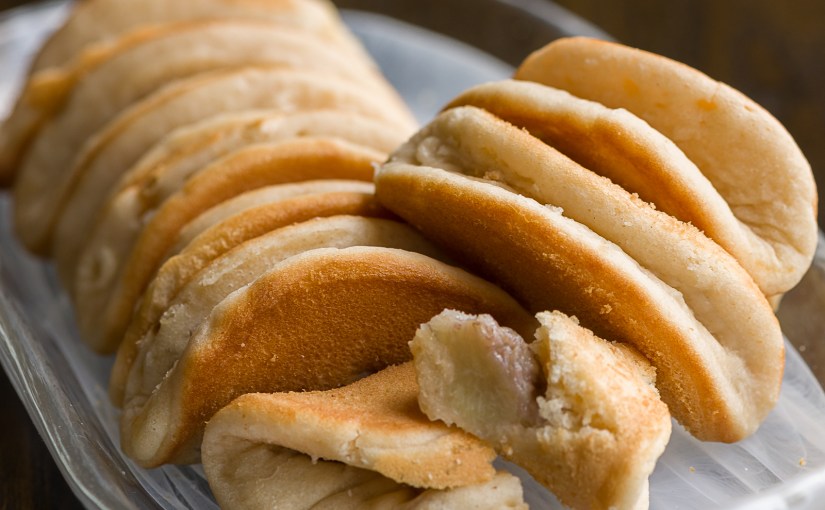
Basically this is a pancake that is enriched with the use of creamy coconut milk, molasses-like palm sugar, and pieces of the durian fruit or banana that gives it a strong and rich flavor that is distinct and hard to describe – pancake a la Nyonya.
When the durian fruit is in season in Malaysia, you can smell it everywhere you go, especially in the markets or near stalls where they are sold. This thorny fruit exudes a flavor and smell that are so pungent that you either have a love or hate relationship with this exotic fruit. The Peranakans have incorporated the custard-like flesh of this Southeast Asian fruit in this dessert in which the fruit’s assertiveness is lessened by its cooking.
I distinctly recall watching my paternal grandmother making this on a specific occasion. It was raining but she was determined that her grandchildren were going to enjoy this snack. Under an overhead ledge by the kitchen, she made a small charcoal fire in a portable burner as she poured the batter and cooked the pancakes with such attention and care. I stood next to her as I observed the whole process with anticipation, and she would give me the first few pancakes for me to eat while they were still piping hot. It was the perfect snack for a cool wet afternoon; there were indeed some benefits that came along with being the cook’s assistant!
If you do not have an Apom mould pan, one with round deep indentations, you may use a non-stick pan or silver-dollar pancake pan, but make sure that the pancakes are not too big, or too thick, about 3 inches (5 cm) in diameter. If you cannot find fresh durians, you can find frozen ones in Asian markets (or you may make this with just ripe bananas which is equally delightful), although the strong sulfur oxide-like smell will not be present, which may be a relief for some sensitive noses!
Recipe from Edible Memories e-cookbook
Makes around 25 pancakes
50 minutes
150 grams palm sugar (gula melaka) or light brown sugar
1 stalk pandan leaf, folded and tied into a knot
5 tablespoons water
½ head/ 1 cup coconut shavings, fresh
(or ¾ cup canned coconut cream or 1¼ cups canned undiluted coconut milk)
250 gm bleached wheat flour, all-purpose, not self-raising
½ teaspoon baking powder
¼ cup water
1 piece durian fruit or 1 large ripe banana, flesh only and cut into small pieces
Apom mould, silver dollar pancake or regular nonstick pan
Vegetable oil
In a saucepan, add gula melaka or brown sugar, pandan leaf, and 5 tablespoons water. Bring to a simmer for 3 minutes until it is a thick syrup consistency. Pour into a bowl and let cool.
Squeeze milk from coconut shavings into a bowl. Add enough water to squeezed shavings, and resqueeze to make a total of 1¼ cups of squeezed coconut milk. If using canned coconut cream, mix it with water until you have 1¼ cup liquid. If using canned coconut milk, do not dilute this mixture.
In a large bowl, mix the flour and baking powder. Add the sugar syrup into the batter and mix well. Slowly pour the coconut milk into the batter and mix well. Add some water bit by bit (around ¼ cup) and stop once the batter has reached a condensed milk thick consistency that pours into a constant stream. Add the pieces of durian or banana. Stir well to avoid lumps.
Heat the round Apom mould or a skillet on medium-low flame, oil it with a few drops of oil, and wipe off the excess with paper towel. Add just enough batter to cover the bottom (3 inches/5 cm diameter on a skillet), even batter out with a spoon, and cook until the top is quite set but still barely wet on the top. Fold pancake towards the middle and let the two halves stick by pressing down firmly – if the middle is still too runny, cook on both the folded sides until it is set. Remove and set aside. Take pan off heat.
Repeat process by first stirring the batter well, lightly oiling the pan, and wiping off the excess oil with the used paper towel.
Serve pancakes hot or at room temperature.
The hardcopy and e-book of The Baba Nyonya Peranakans book (1st image) and Edible Memories e-cookbook (2nd image) are available – more information on the Homepage.
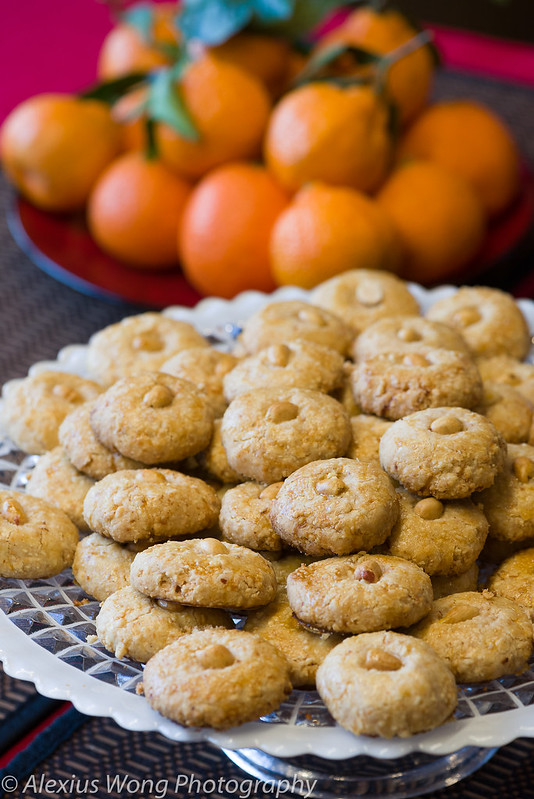
After cooking for around a week, my guests have just left my Lunar New Year Open House. It was the perfect opportunity for me to prepare some of my grandmother’s Nyonya dishes, a treat for my guests over the last few years. This year, I decided to make New Year cookies as dessert, and I started preparations a bit earlier for that. With three attempts to make the special powdery cookies, Kueh Bangkit, resulting in dissatisfaction and disappointment, I resorted to Peanut Cookies, a favorite of mine back when I was growing up in Malaysia. These are very delicate flakey bites with the rich nutty flavor in each crumb. A recent online comment by a reader reminded me of how my grandmother made these with pork lard which gave these sweet bites an added unctuousness that I still recall with great nostalgia.
With success under my belt, here is the simple and tasty recipe, adapted from the Rasa Malaysia website (see page).
Recipe from Edible Memories e-cookbook
Makes around 50 cookies.
Ingredients:
4 cups/950 ml (540 gm) roasted whole peanuts (or oven roast peeled raw peanuts at 300 F (150C) until fragrant and lightly brown), plus extra pieces for decoration
1 cup/240 ml confectionary or icing sugar
1 cup/240 ml peanut oil or lard
2 cups/475 ml all-purpose flour
2 tablespoons shortening or cold butter (only if using peanut oil, not pork lard)
1 egg yolk, beaten slightly with 1 tsp water for egg wash
Method:
Chop peanuts in food chopper until very fine and loose and when the mixture starts to become slightly sticky – do not over-chop them.
Mix the ground peanut, sugar, and flour together until well combined. Cut the shortening into mixture until fine bits. Slowly add the peanut oil and mix well, until the mixture begins to come together – stop adding the oil at this point.
Shape into small balls and place on baking tray lined with parchment paper – do not flatten. Use a toothpaste cap to make the circular indentation by pressing and rotating the cap to lightly flatten the cookie. Or you can press down a peanut half into the middle of the dough.
Brush the sides below the indentation or around the peanut with the egg wash.
Bake at 350 degrees F (180 degrees C) on middle rack for 20 minutes or until brown – check and watch out for burning after 15 minutes and rotate baking tray position if needed be. Check around the bottom of cookie for burning and remove if you smell burning. Remove from oven, take the parchment paper with the cookies off pan, and let cool. When cool, store in airtight container.
The hardcopy and e-book of The Baba Nyonya Peranakans book (1st image) and Edible Memories e-cookbook (2nd image) are available – more information on the Homepage.
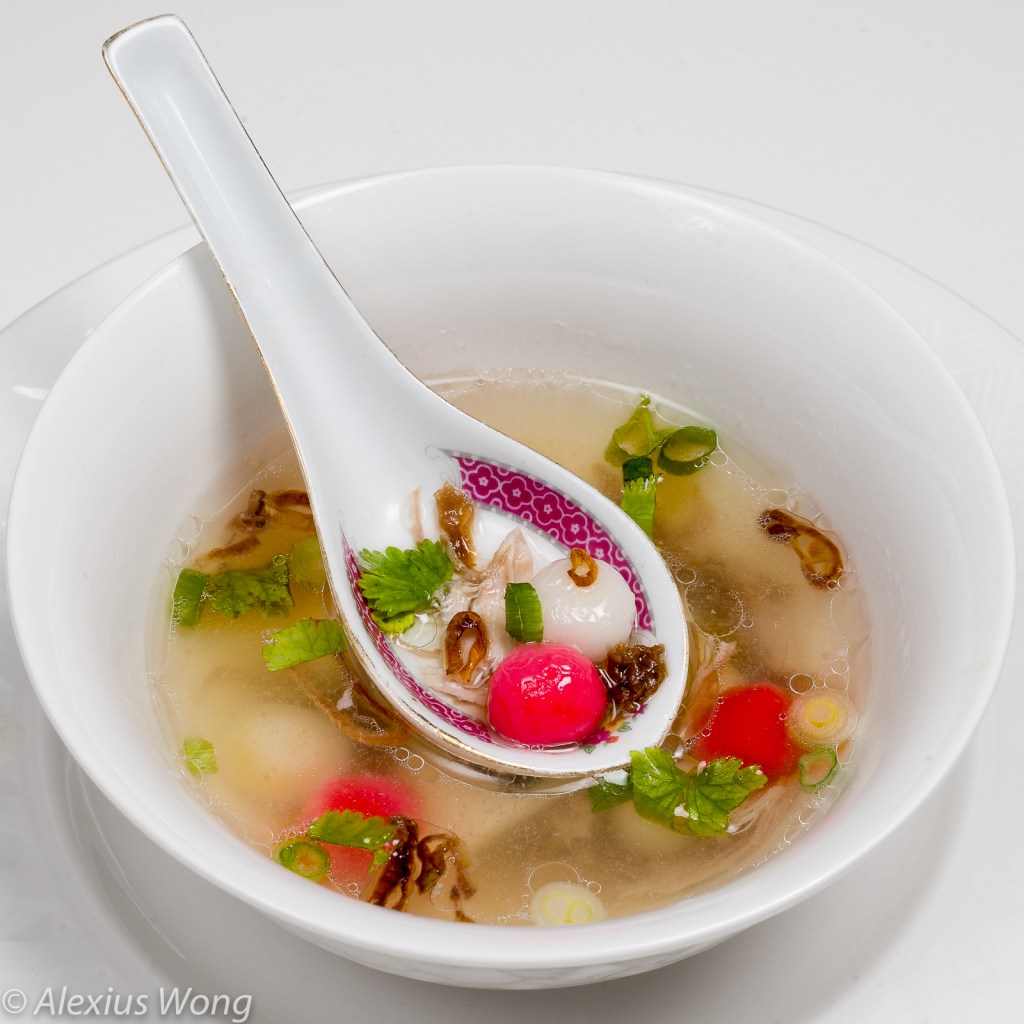
The Winter Solstice ceremony, called Tung Chek in Hokkien, or also known as the Kueh Ee festival among the Peranakans, is celebrated on the 22nd of December in order to mark the end of the agricultural and astronomical year in China. To this day, this custom is still practiced in the Peranakans’ ancestral homeland, the Fujian province of China.
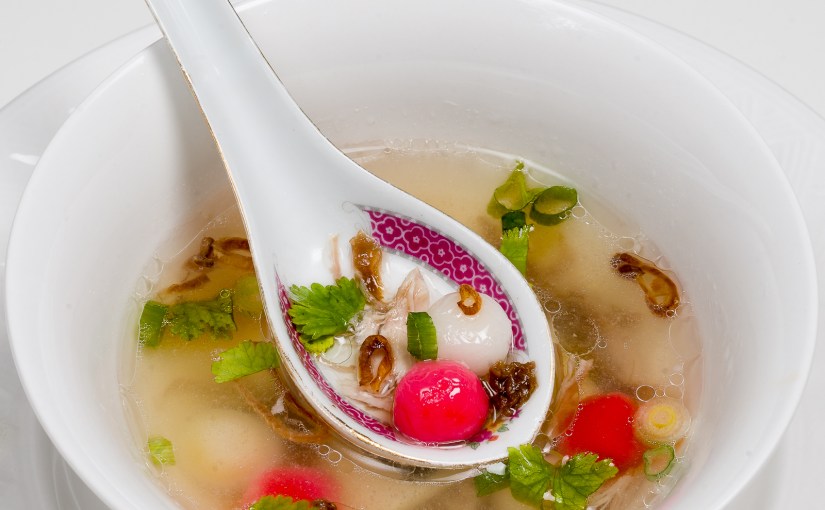
Even though the winter season is unnoticeable in the tropics, the Southeast Asian Chinese transplants continued this tradition with little to no dilution of its original form. For this occasion, the Peranakans would eat kueh ee, which is glutinous rice balls colored red, white, and occasionally green, served in ginger-flavored sugar syrup—the different colors represent the yin and yang forces of nature. For dinner, the Malacca Peranakans would serve the rice balls in a savory fragrant pork and chicken soup, which is how it was celebrated in my family. As part of the observance, large balls of this rice flour would be made and placed as offerings on the home ancestral altar and to the Kitchen God. A pair of the larger cakes (one red and the other white) was placed on each side of the main door for months to attract blessings on the family. Such practices on this specific day were to remind oneself that the whole family had lived through another year. On the other hand, a death in the family meant that the custom would not be observed that year as a sign of respect for the departed one. In the past, this rice ball soup was also customarily served to a newly married couple on their wedding day, as an assurance for the longevity of their new partnership.
The savory soup version is a delicious dish that I feel should be served more than once a year. Since it is only served at the winter solstice, we treat the dish reverently, relishing every drop of the savory soup and the rice balls that have absorbed some of the soup flavors. The garnish of cilantro, scallions, white pepper, Tianjin preserved vegetable (tung choy), fried shallots, and fried garlic are de rigueur since they impart some additional flavor notes to each light sip. The colors of the balls are symbolic, and I have even seen some recipes that use green food coloring, which I find unusual next to the customary red and white. The secret to the dish is to make a rich broth that will flavor the rice balls. The garnishes add a different flavor dimension to the dish, so do not omit these important elements.
NB: A recent posting of this recipe received a lot of hits and some comments that shed some light on this savory version. Many said that they grew up eating this in a Hakka or Toishan household. The parents of my granduncle, Ah Kong, were from Toishan, and my grandmother was adopted by his family. I suspect my grandmother learned the dish from them, hence, it is a tradition what we continue in our family.
Recipe from The Baba Nyonya Peranakans book
Serves 4
Preparation time: 1 hour, 15 minutes (1 hour for making stock)
500 grams (1 pound) pork bones, with bits of meat attached, or 4 cups chicken stock
1 chicken drumstick or 100 grams (3½ ounces) lean pork
5 cups water, plus more for rice balls
Vegetable oil, for frying
3 garlic cloves, minced
5 small (50 grams/1¾ ounces) shallot, peeled, sliced into thin rings
1 scallion, chopped into ¼-centimeter (⅛-inch) pieces
Leaves from 1 stalk coriander (cilantro), finely chopped
Pinch white pepper
Put the pork bones and chicken in a pot with 5 cups of water, cover, and bring to a rolling boil. Lower the heat to a simmer (you may continue to steps 2 and 3). Remove the drumstick after 30 minutes and let cool in a bowl of water—shred the meat and reserve. Let the stock continue simmering for 30 minutes more. Turn off the heat and remove the pork bones. When cool, remove the meat from the bones and cut into small cubes.
In a pan on medium-low heat with enough oil to cover the base, fry the garlic until golden-brown. Remove, drain well, and set aside. Fry the shallots in the same way. Reserve for garnishing.
In a large bowl, add all the flour and then water bit by bit until a thick dough forms. Warning: It is easy to make it too runny, so be conservative with the water. The consistency of the dough should be like thick clay, very stiff to the touch and barely sticking to the hand. Work the dough for a few minutes until it is even and smooth.
Divide the dough in half, and add coloring to one half until it is red enough. You can test this by dropping a small amount of dough into boiling water (the color should be bright and rich). Pinch off small amounts of dough and form them into balls the size of a small marble or large pea by rolling them between your palms. Place the rolled dough on a plate.
Bring a saucepan of water to a boil. Cook the white dough in the boiling water until fully cooked or until they start to float in the water. Remove to cool in a bowl of cold water. Repeat the process with the red dough.
Taste the Tianjin preserved vegetables. If they are too salty, soak them in water for a minute. Remove and squeeze dry.
Bring the stock back to a boil. Add only a bit of salt until barely salty—the preserved vegetable will add more salt to the soup. Add a few dough balls, a pinch of Tianjin pickle, and bits of chopped meat to a serving bowl. When the soup comes to a boil, immediately spoon it over the ingredients in the bowl.
Garnish the soup with the garlic, fried shallot rings, scallion, coriander, and a pinch of white pepper. Serve immediately.
The hardcopy and e-book of The Baba Nyonya Peranakans book (1st image) and Edible Memories e-cookbook (2nd image) are available – more information on the Homepage.
This recipe is quintessentially representative of Nyonya cooking due to the use of a full-flavored and spicy rempah (spice paste) as the stuffing for the simple fish. I recall eating this dish often for dinner when Mamah was alive, as this was one of the dishes in her extensive culinary repertoire. She used to stuff a whole fish with the spice paste and then pan-fry it until the fish was cooked through. I distinctly remember her tearing away pieces of the sambal-smeared flesh from the whole fish with her nimble fingers during dinner, the way most Peranakans used to eat during her time.
I recall a very touching story that Mamah once told me when I was still a preteen. During the Japanese Occupation of Malaya during the Second World War, there were many air raids that took place, and before such bombings occurred, sirens would go off as a warning. At one point, such raids had been taking place for a long period of time, preventing the inhabitants from leaving their homes for a few days. Needless to say, the local market had not opened during that time, and after a few days, people were desperate for food and other provisions.
After a brief period of quiet, the market was open again. Mamah went to the market in search of food for the family, and she went over to the fishmonger to barter over a piece of fish. Suddenly, the sirens started wailing and everyone panicked as they ran for cover to hide from the menacing airplanes. My grandmother froze, torn between running for her life and fending for her loved ones who were very hungry. In a split second, she grabbed the biggest fish on the cart and made a mad dash for home. When I heard the story, I marveled that an unassuming, small-framed woman had such tenacity to fight for survival under the most difficult circumstances.
In this seafood recipe, the secret to the tasty stuffing is the use of small red onion (preferably Bombay onion) that has a certain sweetness, dried chili peppers for depth of flavor and spiciness, and tamarind paste, which is essential in bringing an acidic and sweet flavor profile to the mix. I have seen recipes that use ingredients that unnecessarily complicate the flavors, like fresh red chili peppers and lemongrass—I believe that this recipe is tasty enough with fewer ingredients, just as my grandmother used to prepare it. Since the fish has to cook for a long period of time, my grandmother would use an oilier type of fish, like chub or Indian mackerel (Malay: ikan kembong) or Torpedo Scad (ikan cencaru/cincaru), since the spice paste would keep the fish moist during the cooking process. However, other types of white firm-fleshed fish can be easily substituted.
I have written a simpler method where the chili paste can be served alongside pan-fried fillets. When you cook and serve this spicy dish, you will understand why this was a weekly staple in our family dinners, delicious enough to make you want to eat it with your fingers, Peranakan-style.
Recipe from The Baba Nyonya Peranakans book
Serves 4 to 6
Preparation time: 45 minutes
15 dried chili boh or Kashmiri peppers, or chile puya, stemmed and seeded (or 3 tablespoons dried chili paste)
1 very large/250 grams (8 ounces) red onions (not shallots), peeled and coarsely chopped
4 tablespoons vegetable oil, plus more for frying fish
1 tablespoon seedless tamarind pulp mixed with ½ cup hot water, strained to remove fiber
¾ teaspoon salt
2 tablespoons sugar
400 grams (14 ounces) white firm-fleshed fish filets, like tilapia, red snapper, mahi-mahi
Sweet/glutinous rice flour
Pour enough hot water on dried chilis to cover and soak until they are soft. Drain and place them in a food processor, then purée into a fine paste. Remove and set aside.
In the food processor, purée the onion, garlic, and belacan into a fine paste. Remove and mix with the chili paste.
In a pan on medium-high heat, heat the oil. Fry the chili-onion paste until aromatic, about 6 minutes. Then add 12 tablespoons of tamarind juice, and the salt and sugar, or to taste. Reduce the heat to medium. Cook, uncovered, until very thick but not too dry, about 12 minutes. Remove and set aside.
Cut the fish fillets into bite-size pieces. Pour enough flour into a shallow dish/plate to cover the base, and dredge the pieces of fish. Dust off any excess flour.
Add some oil to the pan on medium-high heat, and fry the fish until both sides are golden brown. Drain well and place on paper towels. Remove and serve with the chili-tamarind paste on the side or smeared on top.
Note: You can fry the fish Nyonya-style by smearing the chili paste into a slit in a thick fillet, or stuffed into slits made in whole fish, and frying until completely cooked. Continuously spoon hot oil over the fish to baste it during frying.
The hardcopy and e-book of The Baba Nyonya Peranakans book (1st image) and Edible Memories e-cookbook (2nd image) are available – more information on the Homepage.
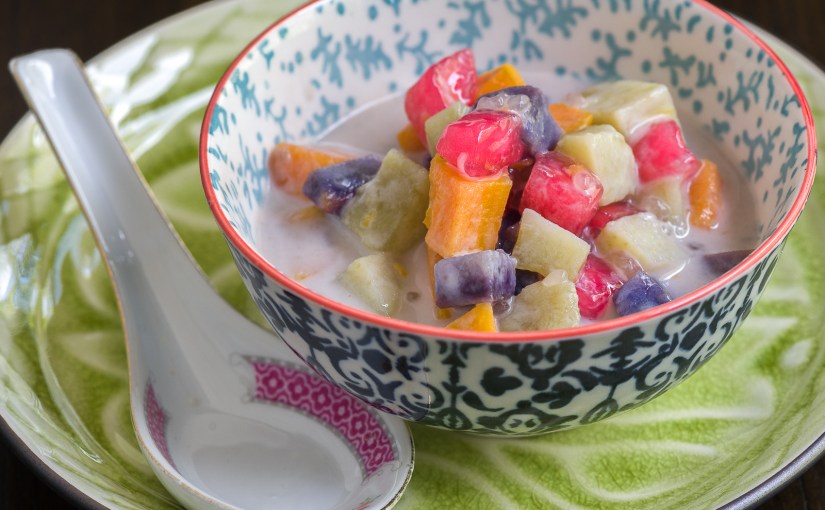
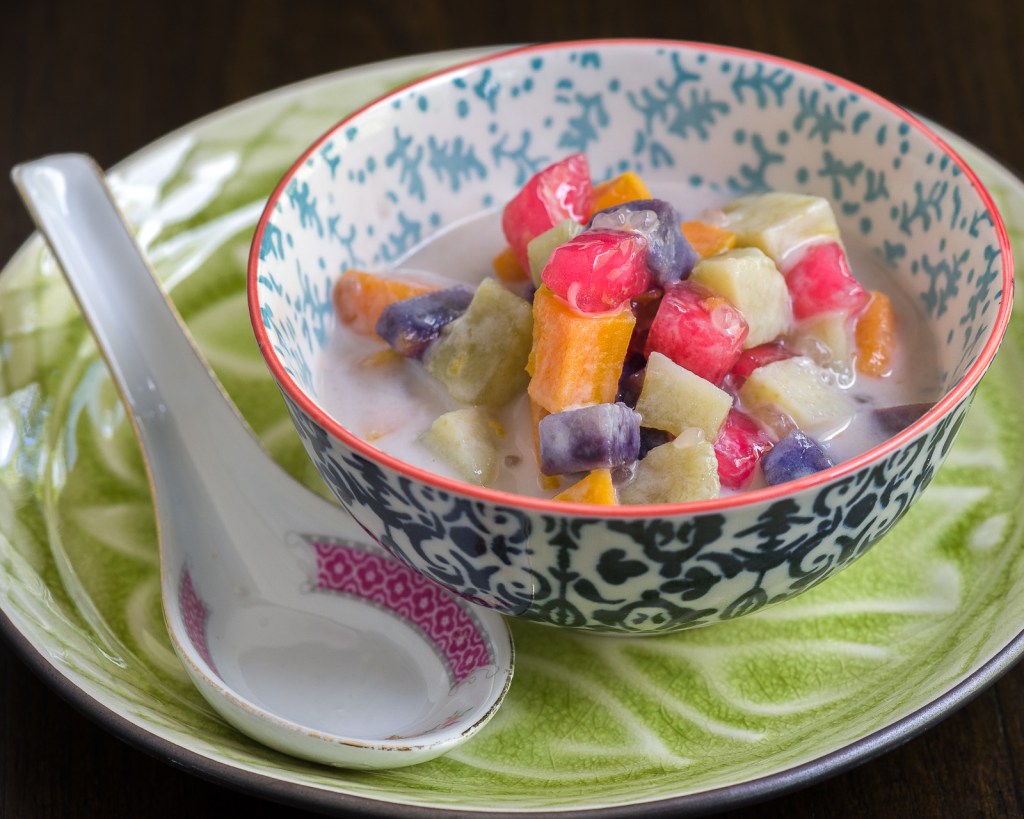
In making this dessert, we see the use of starches other than the usual rice: purple yam, sweet potato, and taro root—common Southeast Asian tubers. The velvetiness of the cooked root starches matches the rich, thick, and sweet broth with tiny sago pearls and bits of chewy cooked tapioca gluten swimming in it. The list of ingredients is typically found in Nyonya desserts: rich coconut milk, caramel-like gula melaka (palm sugar), and fragrant pandan leaf. This sweet soup can be served warm or cold, hence its consumption by my family at any time of the day or night.
Traditionally, this dish was a simple preparation of the tubers and chewy uncolored tapioca gluten bits. Nowadays, the dish has been modified with the chewy bits stained red, green, blue or yellow, which makes the dessert visually more appealing. When dealing with the sticky tapioca dough, make sure to wet your hands and the knife; this ingredient adds a chewy textural element to the dish reminding one of gummy bears. The original recipe only uses the tapioca flour gluten instead of the sago/tapioca pearls—you may choose which one to include, or maybe even both, a common choice these days. Since canned coconut milk comes in different consistencies and qualities, I have made the necessary adjustments.
This is a fairly rich dish, so it is usually served in small portions in the diminutive colorful Peranakan bowls described in the above reading. As no surprise, I would find my family members sneaking into the refrigerator in the middle of the night to have an additional serving. Once you make and savor this rich flavorful dish, you may find yourself doing the same and perhaps bursting into a spontaneous Cha Cha dance, from which this dessert takes its name!
Recipe from The Baba Nyonya Peranakans book
8 servings
Preparation time: 1 hour
½ taro root, peeled and cut into 1-centimeter (½-inch) cubes, or 1 medium (250 grams or ½ pound) Asian purple sweet yam (Malay: keledek)
1 medium (250 grams or ½ pound) Asian yellow sweet yam (Malay: keledek), peeled and cut into 1-centimeter (½-inch) cubes, or 1 sweet potato
3 pandan leaves
2 cups (475 ml) fresh or canned regular coconut milk, or 1½ cups (350 ml) canned thick coconut milk plus ½ cup water
½ teaspoon salt
100 grams or 3½ ounces gula melaka (palm sugar), or ½ cup light brown sugar
3 tablespoons water
50 grams (1¾ ounces) sago or tapioca pearls, around 2 mm diameter
50 grams (1¾ ounces) tapioca flour — optional
Food coloring (any color) — optional
Place the taro root and yam (or sweet potato) cubes on a steaming plate. Place 2 pandan leaves in the steaming water and steam the roots for 15 minutes or more until completely cooked or just fork-tender.
In a saucepan, simmer the coconut milk with the salt, uncovered, for 5 minutes until slightly thickened. Set aside.
In a separate saucepan, mix the gula melaka with the water, add 1 pandan leaf (tied into a knot), and bring it to a brief boil. Set aside to cool with pandan leaf in it.
In a fine-mesh sieve, wash the sago pearls well until the water is clear, then drain it well. In a pot, boil the sago in plenty of water for 5 minutes or until the center is transparent and cooked. Strain into a fine sieve, drain, and set aside.
To make the tapioca gluten (optional): In a saucepan, bring ¼ cup of water to a boil. Pour all the boiling water in one go onto the tapioca flour in a bowl, add a few drops of the food coloring, and mix well until a thick dough forms. Fill a saucepan with lots of water, and bring it to a boil. Meanwhile, turn the dough mixture onto a small cutting board. With wet hands, shape the dough into a thin roll. Dip the tip of the knife in a bowl of water, and cut the dough at a diagonal to get 1-centimeter- (½-inch-) wide small square or triangular pieces. Once the water is boiling, place the pieces into the boiling water. The pieces are done when they are translucent and begin to float, 1 to 2 minutes. Remove and keep in a bowl of cold water. Drain well before mixing with rest of ingredients.
In a large bowl, mix all the ingredients together with the coconut milk and syrup (without pandan leaf). Serve warm or chilled.
The hardcopy and e-book of The Baba Nyonya Peranakans book (1st image) and Edible Memories e-cookbook (2nd image) are available – more information on the Homepage.
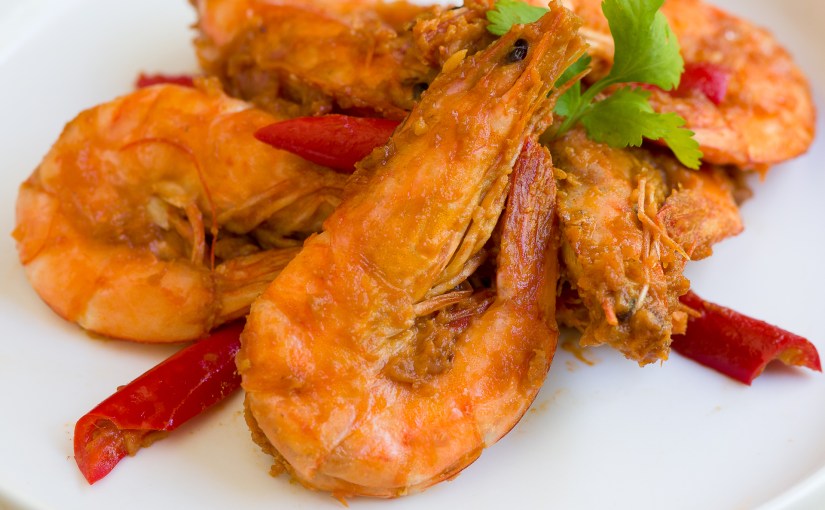
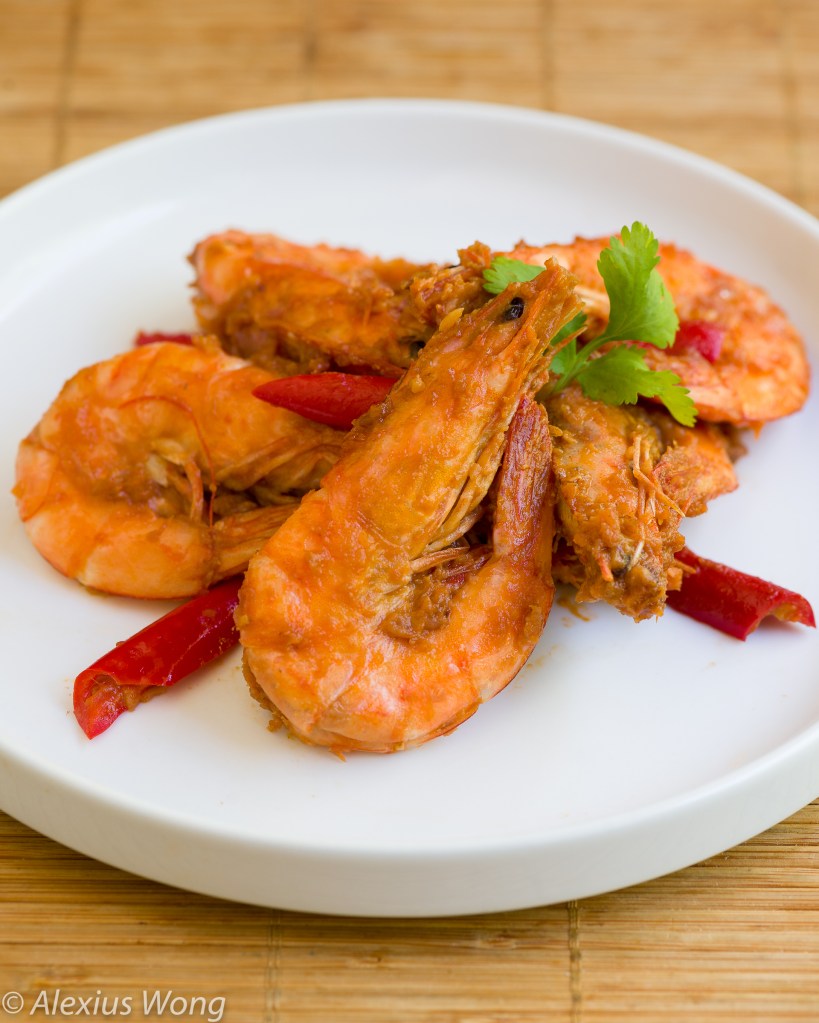
In this recipe, we see the Peranakan’s penchant for using a strong flavor element with a mild ingredient – tamarind. The use of this acidic and slightly sweet fruit perhaps harkens back to its introduction by the Tamils who controlled the Straits of Melaka in the 11th century. This application is not only found in this shrimp dish but also in another made with pork belly.
The basic Nyonya version of this dish is very simple, comprising of only shrimp and tamarind paste as the main ingredients. However, this version is a “supped up” recipe that I learned from Tri Suherni, who worked as my parents’ cook for many years. Here, she brings her Javanese background with the addition of garlic, shallots, chilies, and whole peppercorns into the whole flavor profile.
The shells are kept on the seafood for two purposes. First is to keep the shrimp moist during the cooking, and second, to act as a canvas for the tamarind sauce to hold on to. The deveining process allows the tamarind to permeate the flesh during marination.
The best way to really enjoy this dish is the following. Holding the shrimp by its tail, bite the head off, and savor the sauce while you bite down to release the slightly bitter head juices. After removing the shell from the mouth, bite off a chunk, savor the sauce as you manipulate the shell off the flesh – the deveining facilitates this easy removal. Scoop a spoonful of rice into the mouth and chew the mixture together. After completely working on a shrimp, don’t forget to lick the remaining sauce on the fingers. There is no finer way to enjoy it, which, to me, is totally delightful for this gourmand.
Recipe from Edible Memories e-cookbook
Serves 4
Marination time: 1 to 2 hours
Preparation and cooking time: 15 minutes
500 grams (1 lb) medium-large to large shrimp, unpeeled and deveined
2 tablespoon unseeded tamarind pulp, mixed well with ½ cup room-temperature water and strained
5 whole white peppercorns
2 cloves garlic, peeled and chopped roughly
5 small/50 grams shallots, peeled and chopped roughly
4 tablespoons vegetable oil
2 red chili peppers, stemmed, seeded, and cut into half lengthwise and into 1-inch pieces
Salt
Sugar
If shrimps are not deveined, follow these steps:
Holding the shrimp in one hand, hold a small serrated knife on other hand, and start at the top of the first shell after the head. Cut into the shell and into the flesh all the way until before the last segment before the tail, deep enough to expose the vein – do not go deeper than the vein. Remove the vein and dip it with the fingers in a bowl of water to release it.
Snip off the end of the shrimp nose and the antennae with a pair of scissors or a knife. Add the shrimp to a large bowl, and drain the shrimp very well of water. Add the tamarind paste, and mix well. Marinate for 1 to 2 hours in the refrigerator.
When the marinated shrimps are ready:
In a food processor, add the peppercorns and crush into fine bits but not into a fine powder. Add the garlic and shallots, and process into a fine paste. Remove and reserve.
In a pan on medium-high heat, add the oil. Add the processed mixture and fry for 2 minutes until aromatic. Add the marinated shrimp and tamarind mixture, and add ½ teaspoon sugar and ½ teaspoon salt, or to taste. Cook each side of shrimp for 2 minutes only. Add the chilies and stir for 2 minutes until the sauce is completely dry. Serve immediately.
The hardcopy and e-book of The Baba Nyonya Peranakans book (1st image) and Edible Memories e-cookbook (2nd image) are available – more information on the Homepage.
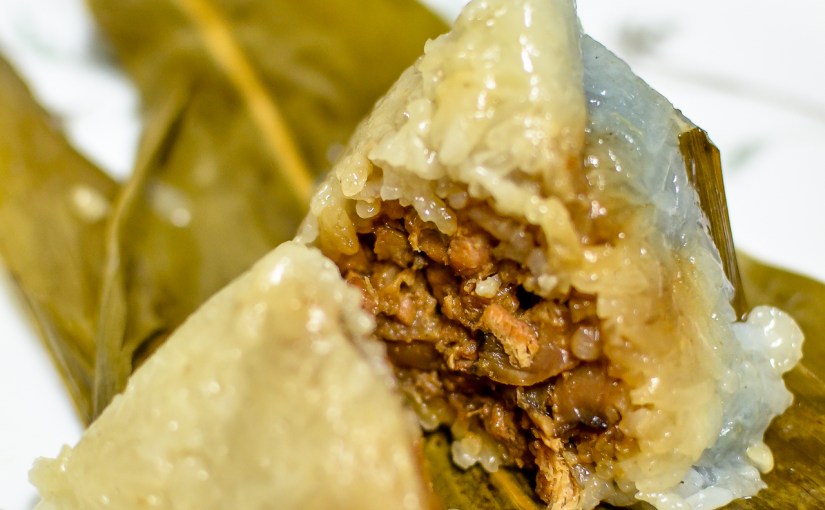
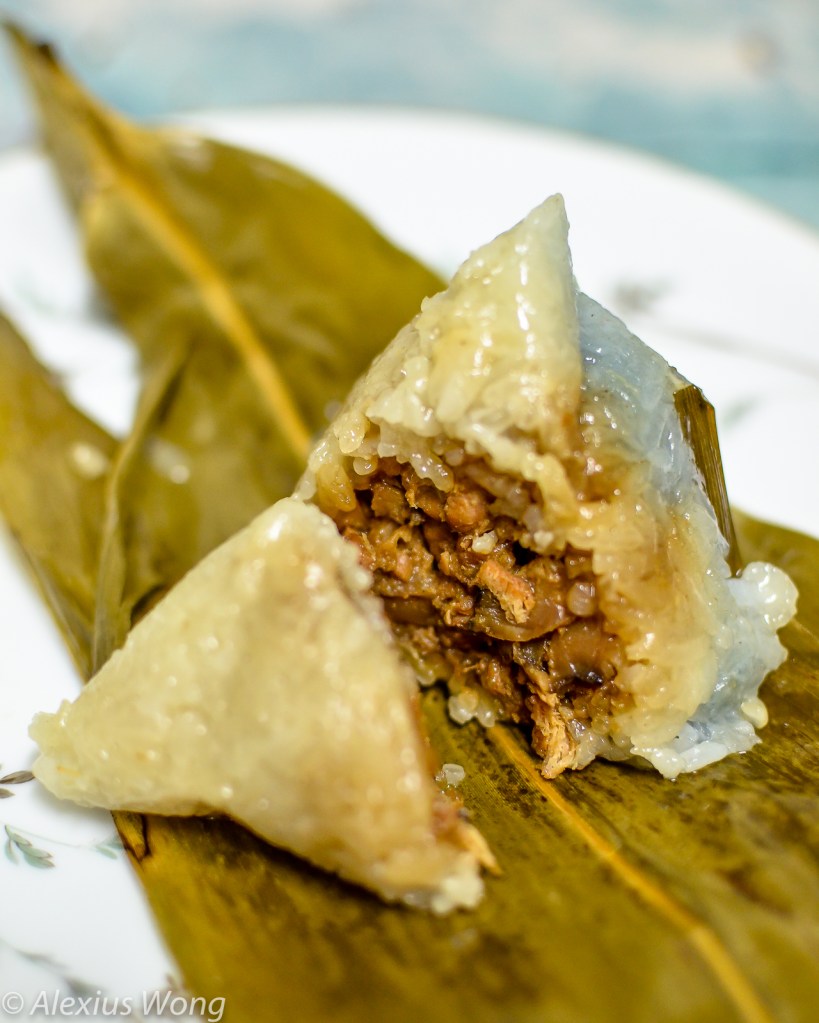
The Summer Festival is celebrated on the fifth day of the fifth month (the “double fifth”) of the lunar calendar (7th June this year). It is also known as the Kueh Chang festival, which is closely associated with the Dragon Boat Race Festival. In preparation for this special day, Nyonya ladies would get together and spend time making kueh chang dumplings, consisting of glutinous rice and usually with a stuffing in the middle, all wrapped in bamboo leaves from China (they are larger and preferable to the local Southeast Asian leaves). In some Peranakan communities, savory meat dumplings known as kiam bak chang are popular. However, in the Malacca Peranakan community, sweet meat dumplings known as kueh chang melaka are made instead, along with kueh chang abu that are made with an alkaline solution and paired with a choice of either sweet coconut jam (sri kaya) or palm sugar syrup (gula melaka) to temper the dumpling’s slightly bitter taste.
On the day itself, the dumplings are given to relatives and friends in remembrance of the Dragon Boat Festival. This celebration has its roots in an ancient belief of the Wu and Yue people of eastern and southern China who believed that river dragons controlled the water needed for agriculture. These dragons were fed such offerings in an attempt to control the rainfall necessary for the crops. In time, the festival was associated with another legend in which the poet, Chu Yuan, drowned himself in 277 BCE to protest a prince’s refusal to consider social reform suggested by the poet. Rice dumplings were taken by the rescuers as sustenance while they searched for the drowned poet. Legend has it that to keep the river dragons from feeding on the poet’s body, carved dragonheads were displayed at the helms of the boats, and dumplings were thrown into the river to distract the sea creatures. According to local belief, the dragons, upon ingesting the offerings, then instructed the local people to wrap the dumplings in leaves. This custom is now practiced to represent the qualities of family unity and loyalty, the same ones that Chu Yuan exemplified in his patriotic endeavors.
As a child, I would sit next to Mamah and watch her make this once-a-year kueh chang, mesmerized by her wrapping the various ingredients in leaves. It was astounding to watch the precision that she displayed in the folding of the bamboo leaves into perfectly formed cones, the addition of the right proportion of soaked glutinous rice and meat-mushroom stuffing into the leaf cones, and the deftness of her fingers as she produced tightly sealed, perfectly symmetrical pyramid-like dumplings in a couple of decisive and well-honed hand movements (video). After she shaped the dumplings, my stomach would growl as I impatiently waited to taste my favorite dumpling that was served only once a year for this celebration.
For the anticipation-filled grandchildren, all that mattered was the 2-hour wait while these dumplings were boiled, pulled out, and served piping hot. We used to dive into our plates without any sense of decorum. When this treat was “in season,” I mostly enjoyed them in the morning after they were warmed up in the steamer. As an adult living away from my homeland, I missed partaking in this annual ceremony. With that in mind, my auntie Madam Dolly Lee would freeze a bunch for me so I could enjoy them when I returned to Malaysia months later to visit her and my family. This dumpling truly brings back fond memories of my deceased relatives; even writing about this stirs up a deep yearning within me for these dumplings and their warm familial presence. To satisfy my year-long wait, I would eat them to my heart’s content for breakfast and tea for the next few days.
In the recipe, I have provided an easy alternative for those who, like me, are not deft enough with the bamboo leaves, which produces the same result as the traditional wrapping and cooking method. If you are wrapping the dumplings, make sure to use the leaves from China as they tend to be longer and more appropriate for wrapping.
To this day I have not perfected this elusive skill of dumpling making, despite breaking the folding process down into a science. I guess innate intuition and time-honed culinary skills cannot be easily replaced by book smarts.
Dried bamboo leaves, from China, washed and soaked in water, and striped into 2 long pieces along the spine (optional)
To make the filling
If using whole coriander seeds, toast in a dry pan on medium heat – do not allow to burn by continuously shaking the pan. When they are fragrant, remove seeds to cool down. Crush seeds until a fine powder.
In a pan on medium-high heat, heat the oil and fry the garlic for 1 minute until slightly golden brown. Add the bean sauce and stir well for 1 minute. Add the mushrooms and stir for 2 minutes. Add the pork, melon sugar, and coriander and stir well. Add the water, salt, and dark soy sauce.
Cover the pan with a lid, lower the heat to medium low, and bring the filling to a simmer. Remove the lid and cook until the mixture is quite dry, about 10 minutes. There should be barely any moisture left. Remove and let cool.
To make the rice
In a pan on medium-high heat, heat the oil and stir-fry the garlic for 1 minute until golden brown. Add the rice, salt, and white pepper. Lower the heat to low and stir the rice for 10 minutes until the mixture is quite dry, but not too dry.
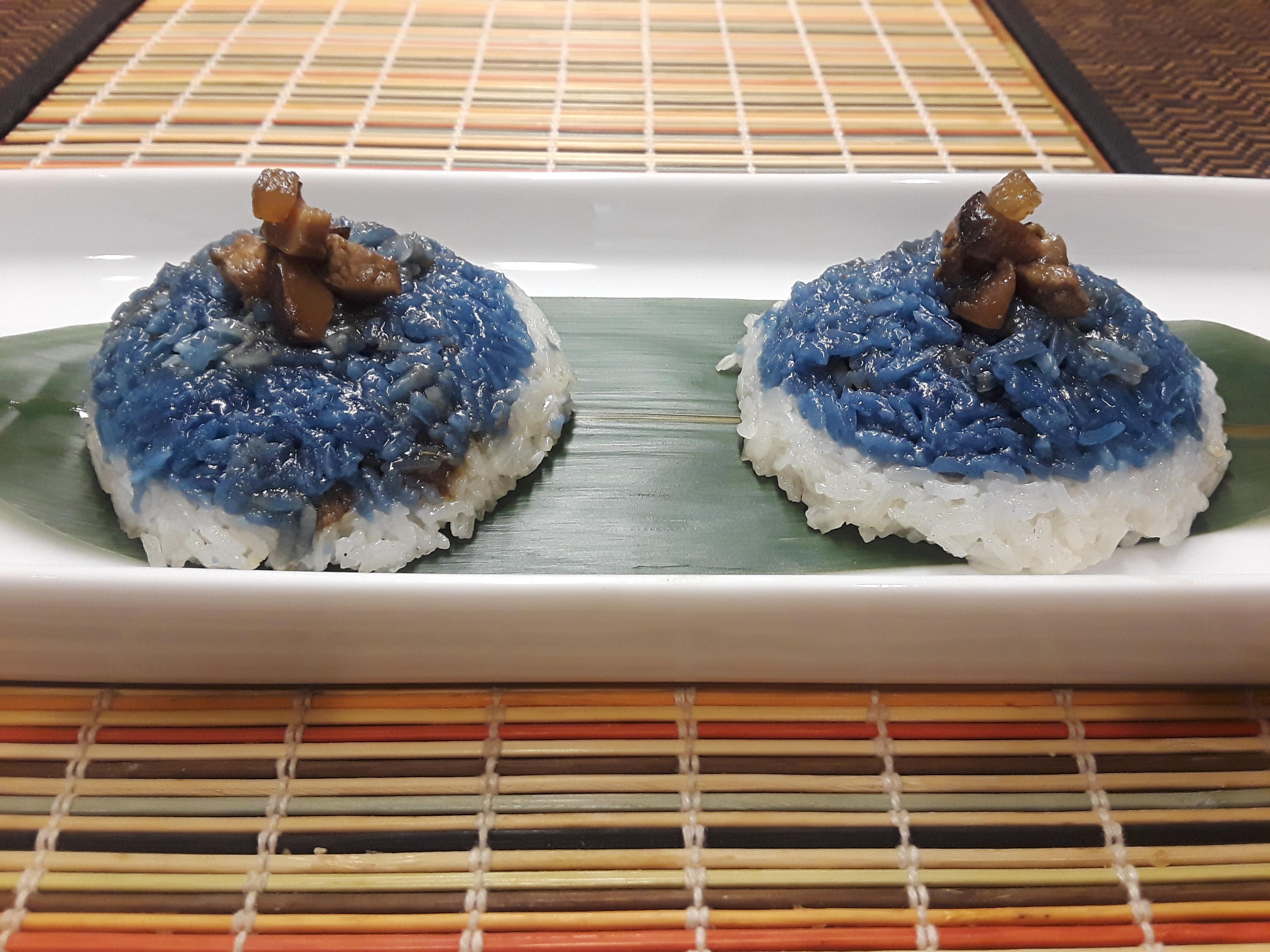
Remove and divide the rice mixture into thirds. Stain one-third with enough bunga telang water to make an even deep color but slightly translucent blue-stained rice (about ½ teaspoon coloring to a tablespoon rice) – use more coloring if necessary.
To assemble and cook the dumplings in bowls:
You can make a medium-size rice dumpling in small rice ceramic bowls. Place the unstained glutinous rice in a wide container like a pie dish. Pour 3 cups of water onto the rice, add the pandan leaves bundle to the simmering water, and steam on medium heat for 20 minutes (you may place bamboo leaves on the bottom of the dish and on top, shiny side touching rice, to add fragrance to the dumpling). After 20 minutes, add another 1 cup of water and steam for another 20 minutes. Remove and cover with plastic wrap.
If cooking a lesser quantity of cooked rice than what the recipe calls for, cover bottom of bowl with strips of bamboo leaf cut to size in a cross fashion with shiny side up, and add three times the amount of water to rice by measuring with the same spoon or ladle, or 2 tablespoons rice plus 6 tablespoons water per rice bowl. Steam until completely absorbed (15 to 20 minutes). Remove bowls, scoop out rice, and cover cooked rice with plastic wrap. Save the bamboo leave strips.
Into empty (or the same) rice bowls, place back the strips of the bamboo leaves, shiny side up, and add 1 tablespoon of blue-stained rice and 2 ½ tablespoons of water. Steam for 15 minutes.
Remove the bowls from the steamer. Make a slight indentation in the rice, add 1 heaping tablespoon of meat filling, and cover the mixture with 3½ tablespoons of cooked unstained rice, or the initial amount steamed in the bowl. Press down the top surface firmly and evenly with the backside of a spoon, and steam for 15 minutes. Remove and cover with plastic wrap while they cool down. Press down the top firmly to compact the dumpling. Refrigerate any unconsumed portions in the bowls.
To serve, loosen the rice from the side of the bowl with a tablespoon or butter knife before inverting it onto a plate.
To reheat unconsumed portions, steam the uncovered bowls for 15 minutes on medium-low heat.
You can also wrap the dumpling the traditional way with soaked Chinese bamboo leaves (instructions link). Tips for folding the dumpling is at the bottom of this posting.
Here is a video of the bowl technique:
The hardcopy and e-book of The Baba Nyonya Peranakans book (1st image) and Edible Memories e-cookbook (2nd image) are available – more information on the Homepage.
Tips for folding the bamboo leaves:
– the width of the bamboo leaves is ideally between 4.5 to 5 cms, or wider and not less.
– when putting the 2 leaves together, the shinier side (or side facing the sun) is on the top so that it is the inside of the package, and it has a slight antistick quality for easy unfolding without the dumpling breaking apart.
– try to find a close match of both leaves, length and widthwise. If there is no match, place the shorter or the lesser width one on the top which will end up as the inside wrap. The leaves must face the opposite directions with each other (a leaf tip on top of the other’s branch). With the lesser width leaf, match both leaves on the side closer to you so as to create a strong lip when closing the dumpling with the flap.
– the initial folding on the cone is made at the 1/3 way point on the leaf side. I initially started at the 1/2 way point but there was not enough leaf flap to create a secure seal. Once I adjusted it, all was fine.
– when adding the first bit of rice at the bottom of the cone, a deep indentation has to be made in it so as to allow an even distribution of meat stuffing in the corner, or, if not, the bite there will be pure rice.
– when adding the stuffing, it is added generously to create a mound, not flat, and away from the side leaves. This ensures that the dumpling has the right rice-to-filling ratio, and the dark stuffing would not be showing on the exterior when cooked.
– when adding the rice to the filling, it is added around the filling first. This ensures that the filling is protected by the surrounding rice, and the flavors are not diluted in the boiling process.
– before closing the dumpling, the backside of rice touching the leaf flap is pressed down to lower it slightly. I can’t explain why my grandmother did this.
– after folding and closing with the leaf flap, the excess is turned towards the side where the initial cone makes a small flap located at the bottom of the cone running up on one side. This way, when tying the dumpling, the wrapping string will wrap both the cone flap and excess leaf flap at the same time to produce a secure package.
– when wrapping the string a couple of times around the chang, the loose end is passed next to the string attached to the pole but on the side closer to the cone top tip to ensure that the wrapping stays in place and doesn’t slip down, which will create a loosely wrapped dumpling.
– the traditional seagrass string is the best as if you tie it too tight or hard, it will snap. It allows the correct tension as well as a bit of give for expansion when boiling. Using yarn or plastic string only leads to tying too tight or too much tension, creating a “tali pinggang” effect in the final product.
– the excess leaf flap and string have to be cut off for a prettier bundle.
– when boiling, at midpoint, the bottom ones have to come to the top. Extra boiling water is used to top it off when the water level becomes lower than the top chang.
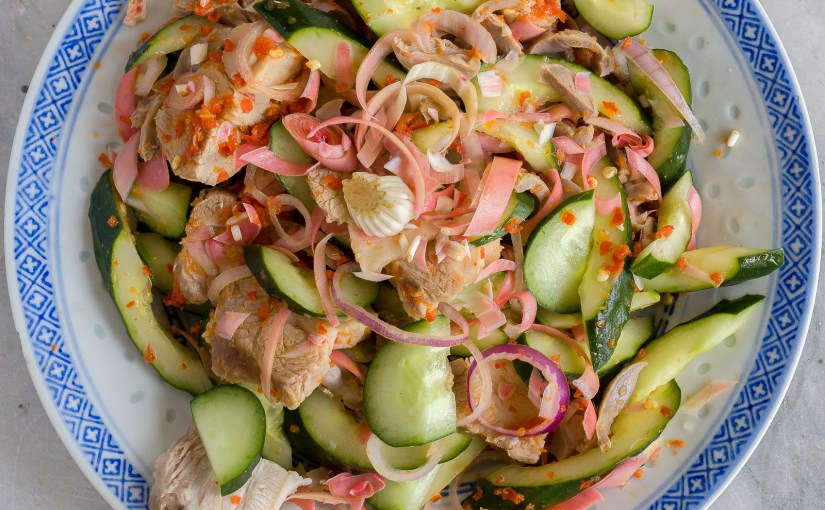
During one of my trips back to visit my parents in Malaysia, I went to get a facial, since it was cheaper there than in the United States. The beautician was a nice chatty lady from Melaka, where my father and relatives hail from. During the session, I started to ask her about what she remembered about Nyonya cuisine while she was growing up there. She listed a bunch of dishes that I was very familiar with, until she started to describe a certain salad dish. At this point, I stopped her and asked her to give me a more detailed description of its ingredients. When she finished describing the dish, I realized then that my family had not eaten this salad since Mamah passed away nearly twenty-five years before. I was so excited about finding a lost culinary treasure that I asked my mother to go the market the next morning to purchase the ingredients, and that night, we recreated the dish.
While preparing this dish, I could not believe that after twenty-five years I still remembered how the dish should taste, the flavor memories still at the tip of my tongue as I adjusted the amount of salt, sugar, chili paste, and lime juice that make up the dish’s seasoning. During dinner, my parents, my aunt, and I were very quiet as we ate the salad. A sense of comfort and reminiscence came upon us, and our eyes looked slightly glazed. At that point, I knew that my grandmother was present then and there through that particular dish—it was a very touching moment for all of us.
An enquiry by me about this dish on a Baba-Nyonya Facebook group produced a lot of responses and some interesting information. First, it confirmed that the dish’s Baba Melayu name was correct, as I had not been sure of its veracity, and that there is a northern Penang version called Kerabu Timun, as well as other versions in the Kelantan Peranakan and the Malacca Portuguese communities. I also learned that my version was missing a key component, pounded dried shrimp or dried brine shrimp (gerago), that brings the dish’s umami factor to another level—for this, I’m grateful for the help of social media and the group Peranakan members for guiding me with this “lost” recipe. Some commented that they grew up eating a version made with boiled pork skin, and my father even remembers a version made with chicken intestine. And finally, many posted that they had not eaten this dish in a long time, including quite a few that wrote that they last ate it when their mothers were alive; a lady remarked she had not tasted the dish for nearly 70 years. This last revelation stirred up in me the same sadness and sense of nostalgia when I rediscovered this recipe years ago as I realize how quickly certain dishes like this one could easily be forgotten or not transmitted to future generations.
Bunga Kantan (Torch Ginger Flower) on the top
This dish is basically a salad incorporating cooked chicken gizzards and pork with fresh cucumber and a full-flavored spicy sauce, made fragrant by slivers of torch ginger flower (bunga kantan). This flower is essential in imparting its citrus-like and uniquely aromatic quality to the dish. However, it is very difficult to find its fresh form outside of Southeast Asia (hence the commissioned photos by a Malaysian friend)—do not use the dry form as it is too fibrous for the dish (you may omit it and still produce a tasty dish). As with the other salad-like dishes, this is not served as a separate course but rather as part of the whole meal. Do not mix the sauce with the meat and cucumber in advance otherwise the cucumber will be soft and the dish too soggy. Hopefully, the flavors in this dish will tickle your palate and touch your heart like it did when my family revived and saved it from possible extinction.
Recipe from The Baba Nyonya Peranakans book
Serves 4
Preparation time: 45 minutes
4 chicken gizzards
250 grams (½ pound) pork belly, skin removed with a bit of fat left on
1 medium cucumber
2 tablespoons dried shrimp, soaked in water for 10 minutes, drained, and pounded or processor chopped not too finely
4 small (40 grams/1½ ounces) shallots, peeled and cut into fine rings
2 tablespoons sambal belacan ; or 3 or Finger Hot red chilipeppers, seeded and stemmed (or 1½ tablespoons chili paste or sambal oelek), plus 6 grams/½ teaspoon belacan (shrimp paste), crushed together into a fine paste
5 tablespoons lime juice (10 limau kasturi or 3 limes)
½ head bunga kantan (torch ginger flower), sliced diagonally, very finely
½ teaspoon salt
1½ teaspoons sugar
Put the chicken gizzards and pork belly into a pot on medium heat, and pour in enough water to cover. Simmer covered for 30 minutes—you may proceed with the next step and prepping the other ingredients. When cooked, remove and slice the pork thinly into slices 2-by-3 centimeters (¾-by-1 inch). Slice the gizzards into very thin long pieces.
Peel the cucumber and halve it lengthwise. Remove the seeds using a tablespoon. Slice the cucumber diagonally into ½ centimeter- (¼-inch-) thick pieces.
In a bowl, combine all the ingredients and mix well. Taste and adjust the salt and sugar levels. Serve immediately.
The hardcopy and e-book of The Baba Nyonya Peranakans book (1st image) and Edible Memories e-cookbook (2nd image) are available – more information on the Homepage.







 Baba Nyonya Peranakans