Baba Nyonya Peranakans informs readers with the History, Culture, Food, and authentic Recipes of this Southeast Asian culture of Malaysia and Singapore.
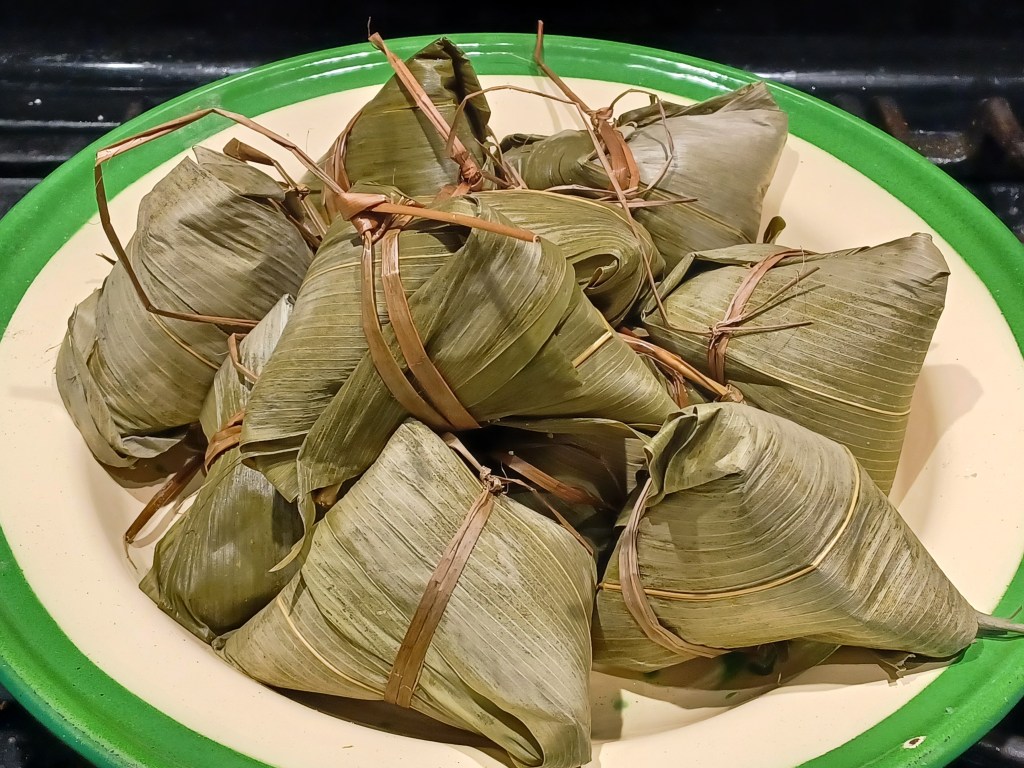
Making Kueh Chang each year reveals a tip that I am gradually remembering from the many years of watching my grandmother make it as I would sit there absorbing all her nuanced moves without me even trying it since I was not capable as a mere toddler. Also, my grandmother, like many Nyonyas like her, did things instinctively without providing explanations. This year, many more memories came back that guided me.
the initial folding on the cone is made at the 1/3 way point on the leaf side. I initially started at the 1/2 way point but there was not enough leaf flap to create a secure seal. Once I adjusted it, all was fine. Also, use long leaves and not shorter ones.
when adding the first bit of rice at the bottom of the cone, a deep indentation has to be made in it so as to allow an even distribution of meat stuffing in the corner, or, if not, the bite there will be pure rice which is not desired.
when adding the stuffing, it is added generously to create a mound, not flat, and away from the side leaves. This ensures that the dumpling has the right rice-to-filling ratio, and the dark stuffing would not be showing on the exterior when cooked.
when adding the rice to the filling, it is added around the filling first. This ensures that the filling is protected by the surrounding rice, and the flavors are not diluted in the boiling process. Also, make sure any rice clumps are broken up before adding to the leaves.
before closing the dumpling, the backside of rice touching the leaf flap is pressed down to lower it slightly. I can’t explain why my grandmother did this.
after folding and closing with the leaf flap, the excess leaf tip is turned towards the side where the initial cone makes a small flap located at the bottom of the cone running up on one side. This way, when tying the dumpling, the wrapping string will wrap both the cone flap and excess leaf flap at the same time to produce a secure package.
when wrapping the string a couple of times around the chang, pass the loose end on the side closer to the cone top tip to ensure that the wrapping stays in place and doesn’t slip down, which will only create a loosely wrapped dumpling.
the traditional seagrass string is the best as if you tie it too tight or hard, it will snap. It allows the correct tension as well as a bit of give for expansion when boiling. Using yarn or plastic string only leads to tying too tight or too much tension, creating a “tali pinggang” effect in the final product.
the excess leaf flap and string have to be cut off for a prettier bundle.
when boiling, at midpoint, the bottom ones have to come to the top. Extra boiling water is used to top it off when the water level becomes lower than the top chang.
With so many nuances, steps, and honed skill needed to create a food product, I think the art of chang making needs to be submitted for preservation as a cultural intangible.
Finally, I have solved a decades-long dilemma – making Sri Kaya/Coconut Cream Jam in around 30 minutes. Despite my penchant for this irresistible Southeast Asian staple (enjoyed in Malaysia, Singapore, Indonesia and Thailand), I shied from making it the traditional way (recipe found in my first book, The Baba Nyonya Peranakans) as it required the laborious process of stirring the custard mixture in a double boiler for around 2 hours. As a result, this highly-favored spread was prepared by me sadly only once a year.
Recently, I was given a batch by a Malaysian friend living down the road, and it got me thinking why I did not put in the effort into recapturing the flavors that were infused in my grandmother’s version, which I highly favored and have wafted through my day and night dreams of this distant longing. As my Mamah prepared this, I was always the eager very young assistant watching the double boiler on a fire fueled by dried coconut husk smoldering in a shallow pit. Watching her was a masterclass of her “agak-agak” skills, using only her well-honed senses to produce the perfect result. One slip in judgement or fire temperature would spell disaster resulting in sweet scrambled eggs, which I produced a number of times when I started testing her recipe.
Within this large conundrum of this deceivingly simple recipe were many challenges in order to produce a very close version to my grandmother’s. First was the time and labor issue – most people these days are put off by long cooking times and the constant vigilance. Then was the challenge of getting the full pandan flavor within a short period of time without resorting to artificial pandan paste, which carry an undesirable taste and color. Another was how to get the pandan flavor within the short process without it leaving a grassy note. To further shorten the time, I have cut the original recipe down into a quarter, which means a shorter time to cook and set the mixture.
Even though the quantity is a fourth of the original recipe, this method ensures that you have a fresh batch that can be made more often and within 30 minutes. This I much prefer rather than not having any due to dreading its time and labor. I hope you enjoy the recipe and be inspired to make this Nyonya classic spread often and bring it back to your dining room.
Ingredients:
1 pandan leaf, fresh or frozen
¼ cup/ 60 ml coconut milk, canned (thick kind)–do not stir or shake it, or 1st pressing from freshly grated coconut
13 grams + 75 grams granulated white sugar, divided
3 large eggs
Equipment:
Microwave/Microwavable plate
Mortar and Pestle
Small saucepan
Medium saucepan
Medium pot
Fine sieve
Straight-sided spatula, preferably silicon type
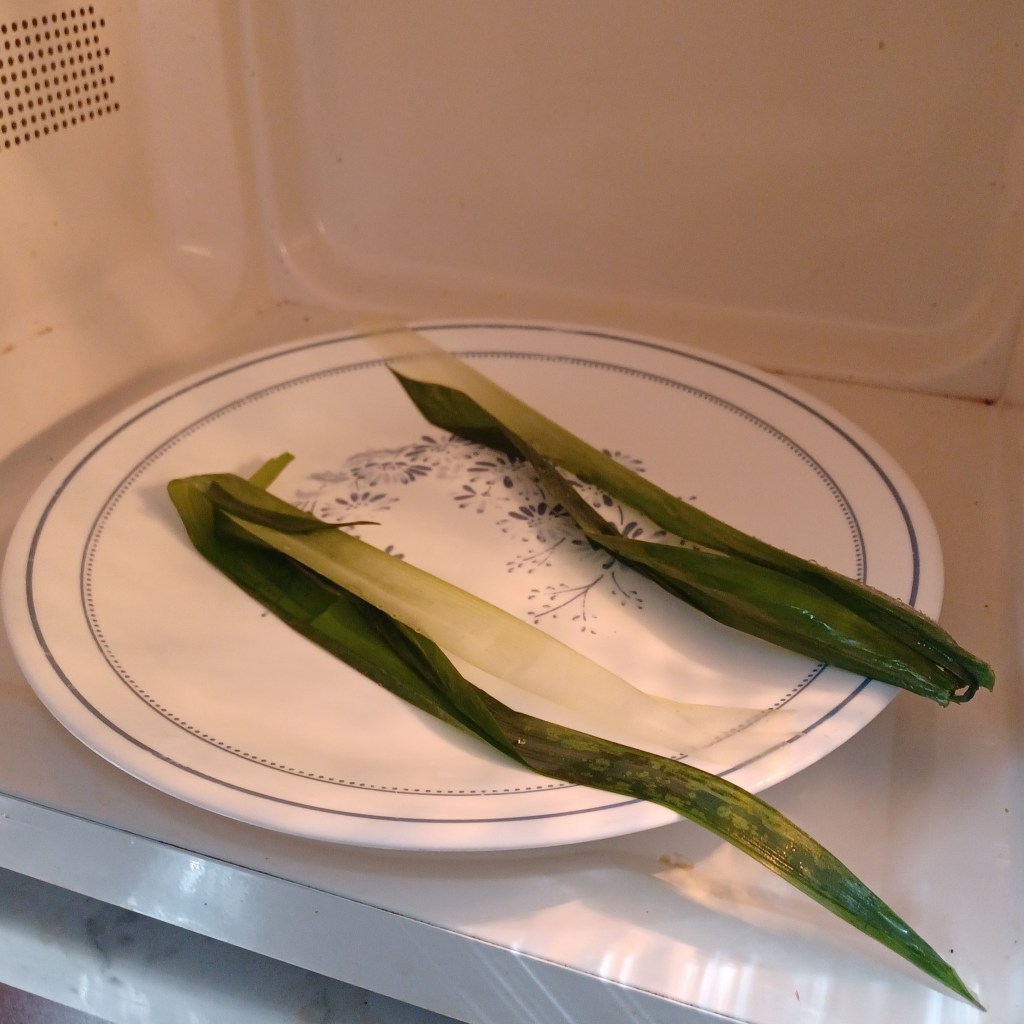
Microwave pandan leaf: If frozen, wash pandan leaf until defrosted.
Place it on a microwaveable plate. Microwave it on high for 30 secs for frozen, or 1 minute or more for fresh leaf until the leaf is wilted.
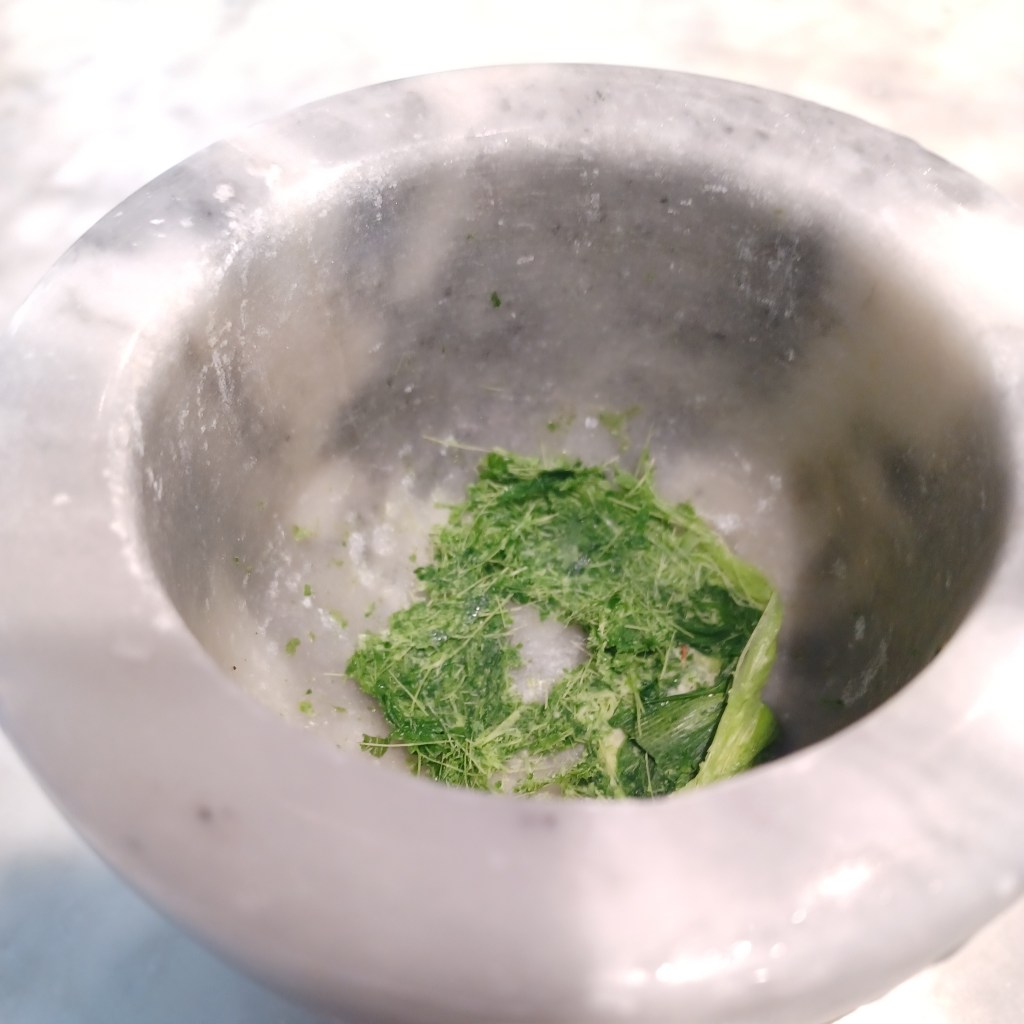
Crush leaf: Using a mortar and pestle, crush the leaf until the fibers are separated [or chop leaf with the coconut milk in a small food processor]. Remove and place it into the small saucepan.
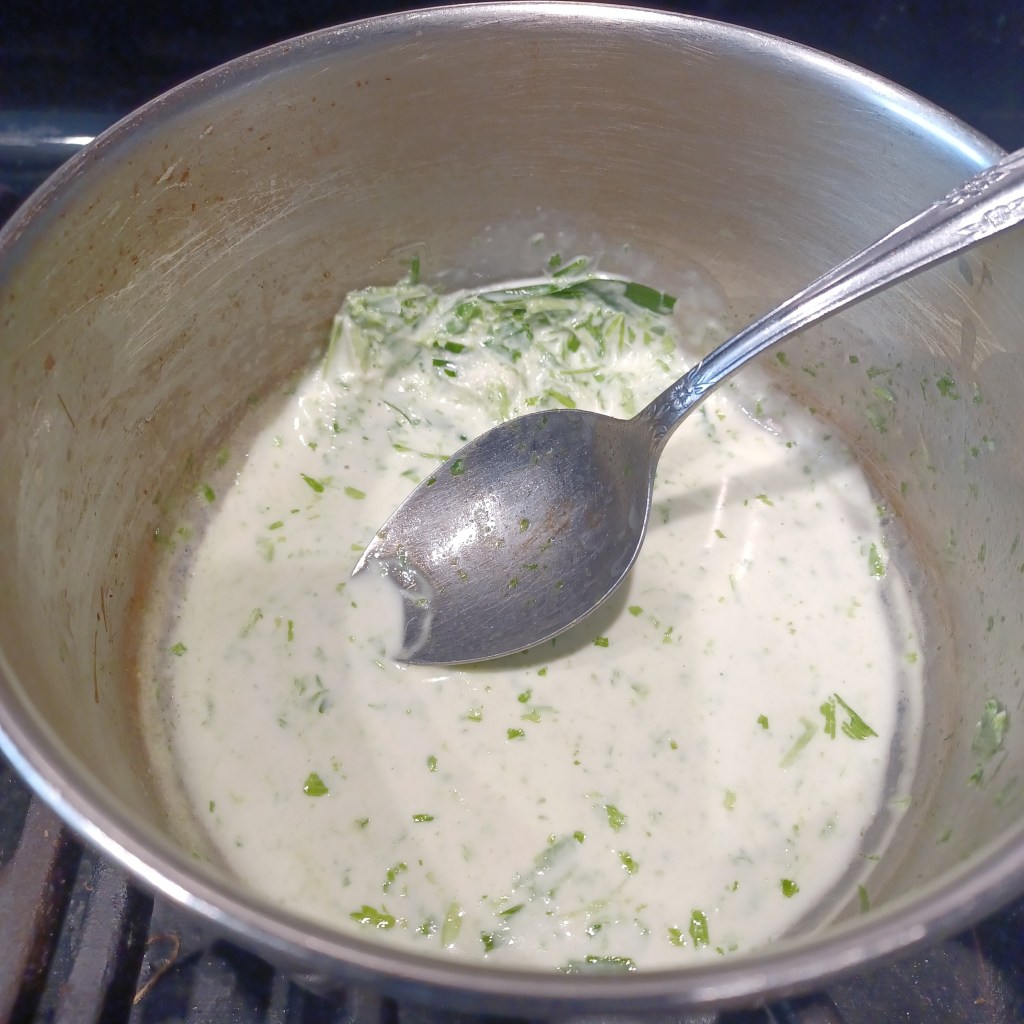
Cook leaf: Scoop the top coconut cream from the can (or fresh 1st pressing) into the saucepan with the leaf. On a small-sized flame on medium heat, bring it to a simmer while using the back of the tablespoon to press the pandan leaf against the sides. Let it only simmer for not more than 1 minute. Turn flame off, cover, and leave it to cool.
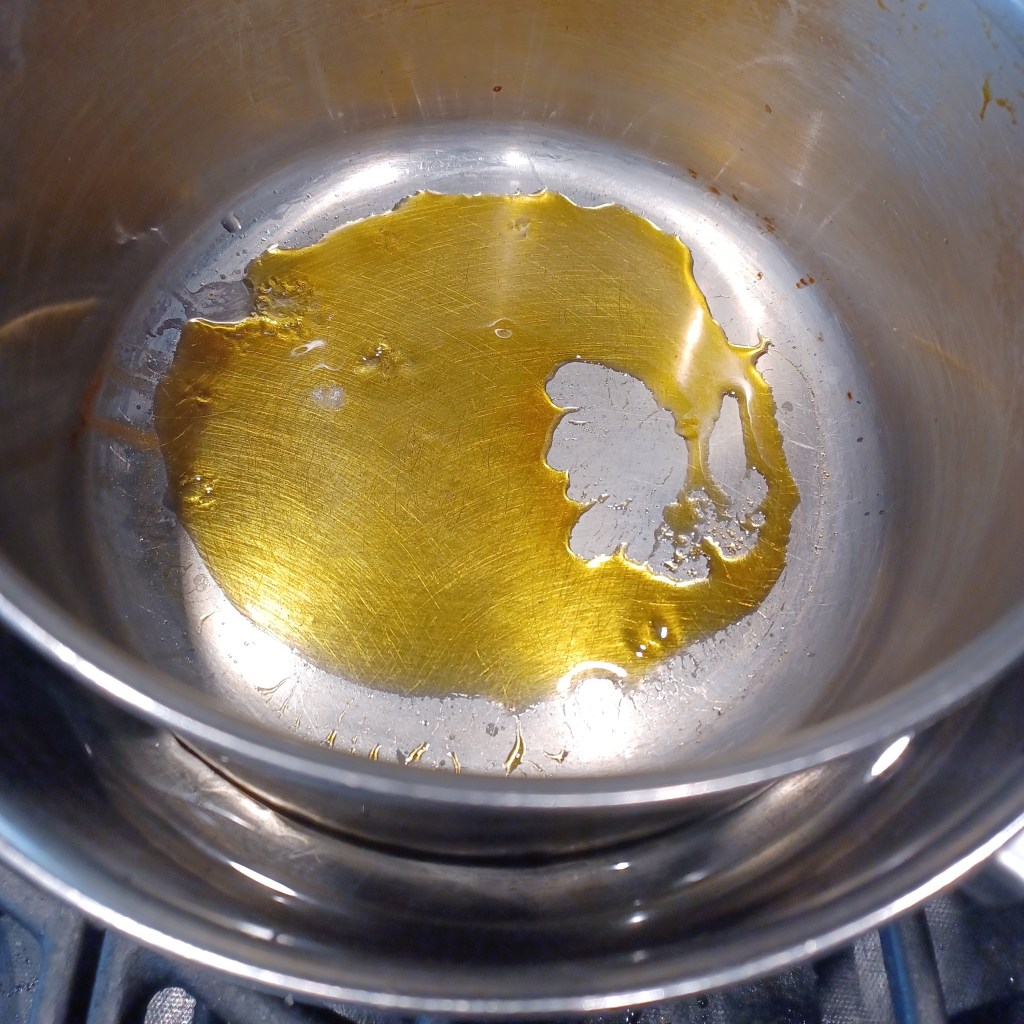
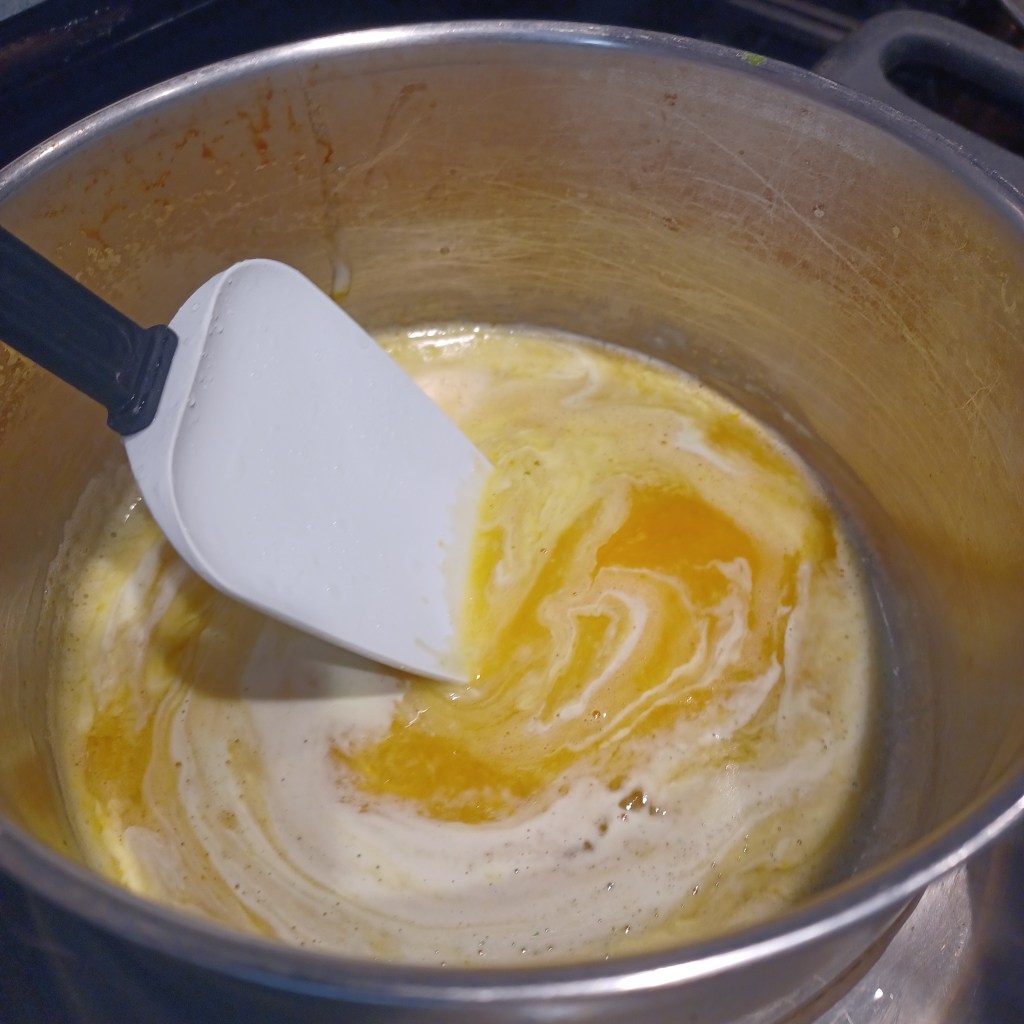
Caramelize sugar: Add the 13 grams sugar into the medium saucepan, and swirl to make sure it is evenly spread out. Place the saucepan on a medium-sized flame on medium heat. Quickly fill up the other medium pot with water until ¼ filled, and place the pot next to the caramel saucepan. Watch the caramelization carefully. You want it to go a blonde or hay color but not past this stage. When the desired color is reached, immediately place the saucepan into the pot of water to stop the cooking. Leave it to cool.
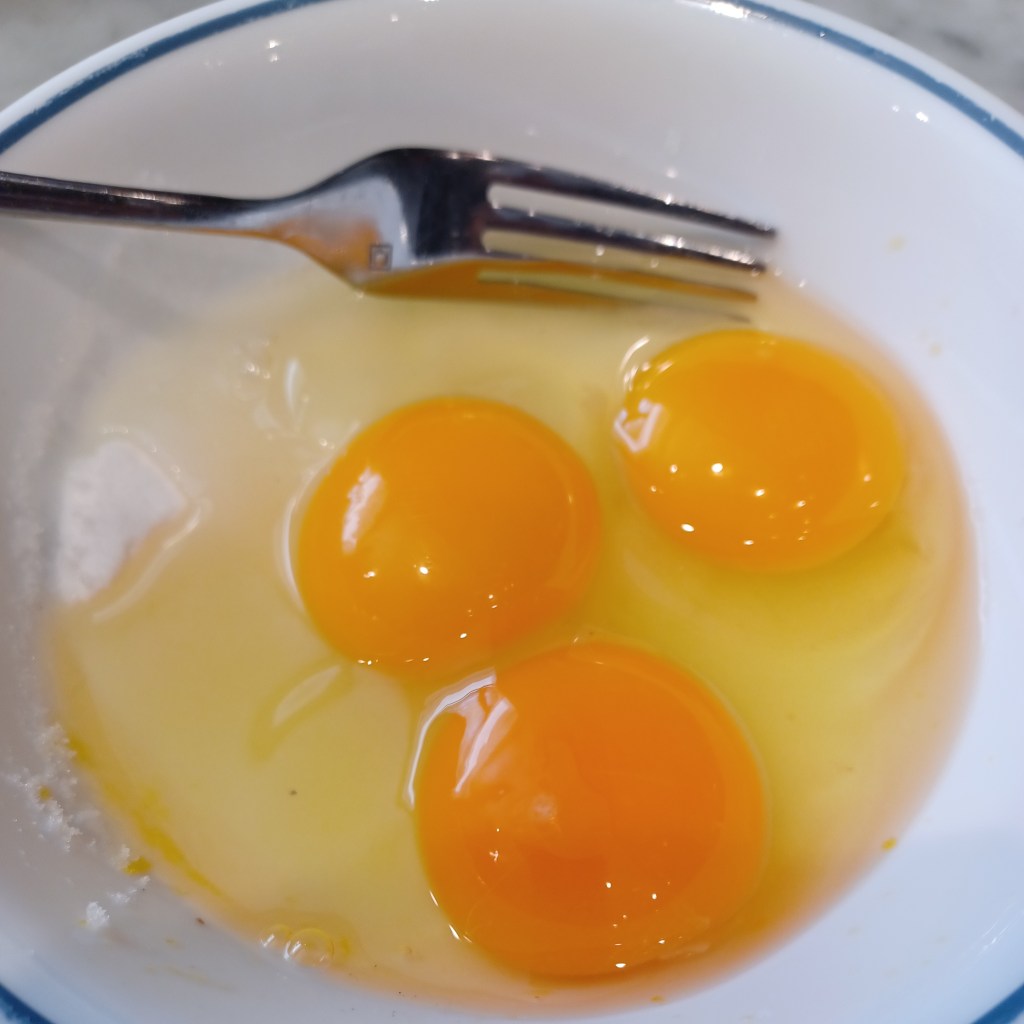
Mix sugar and eggs: In a bowl, add 75 grams of sugar. Break only 2 eggs and add to the sugar. With the 3rd egg, break it and add the whole yolk and only half the egg white. Mix with a fork until the sugar is well incorporated. Set aside.
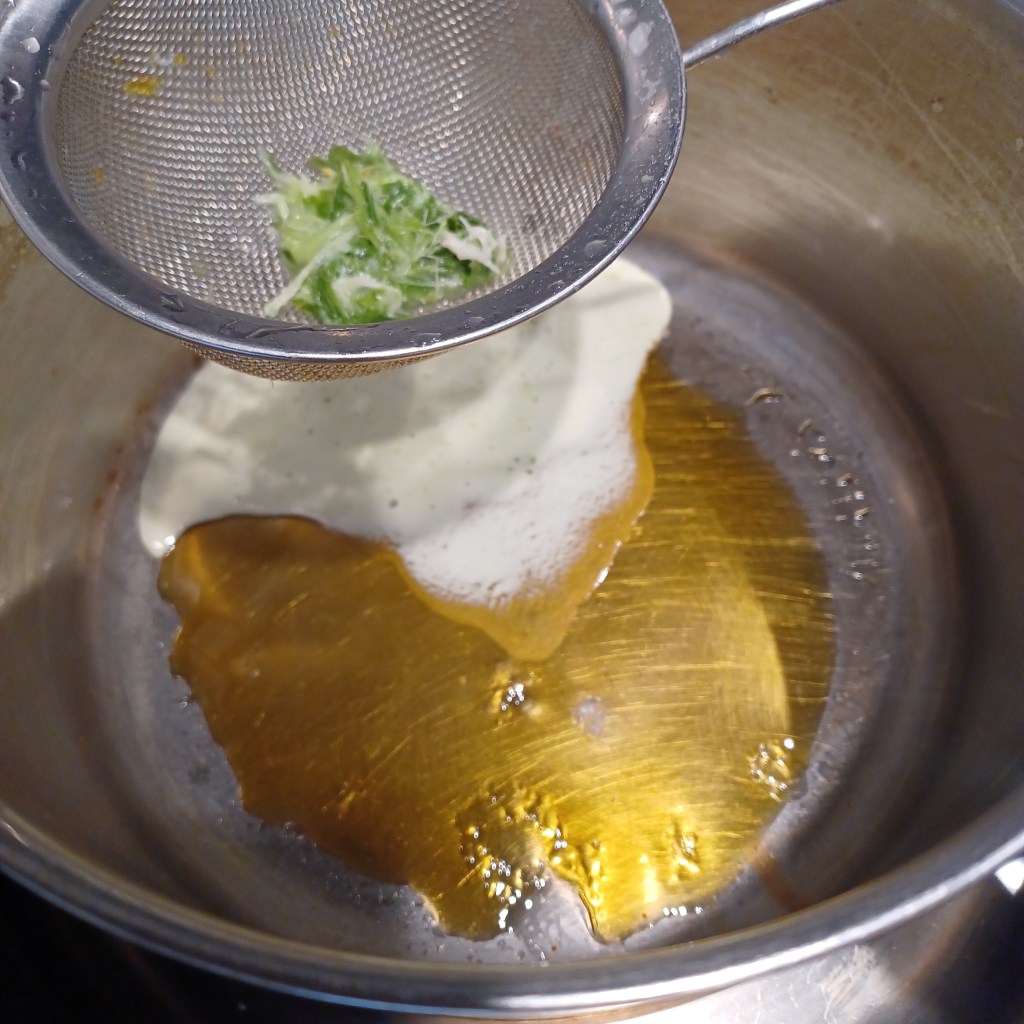
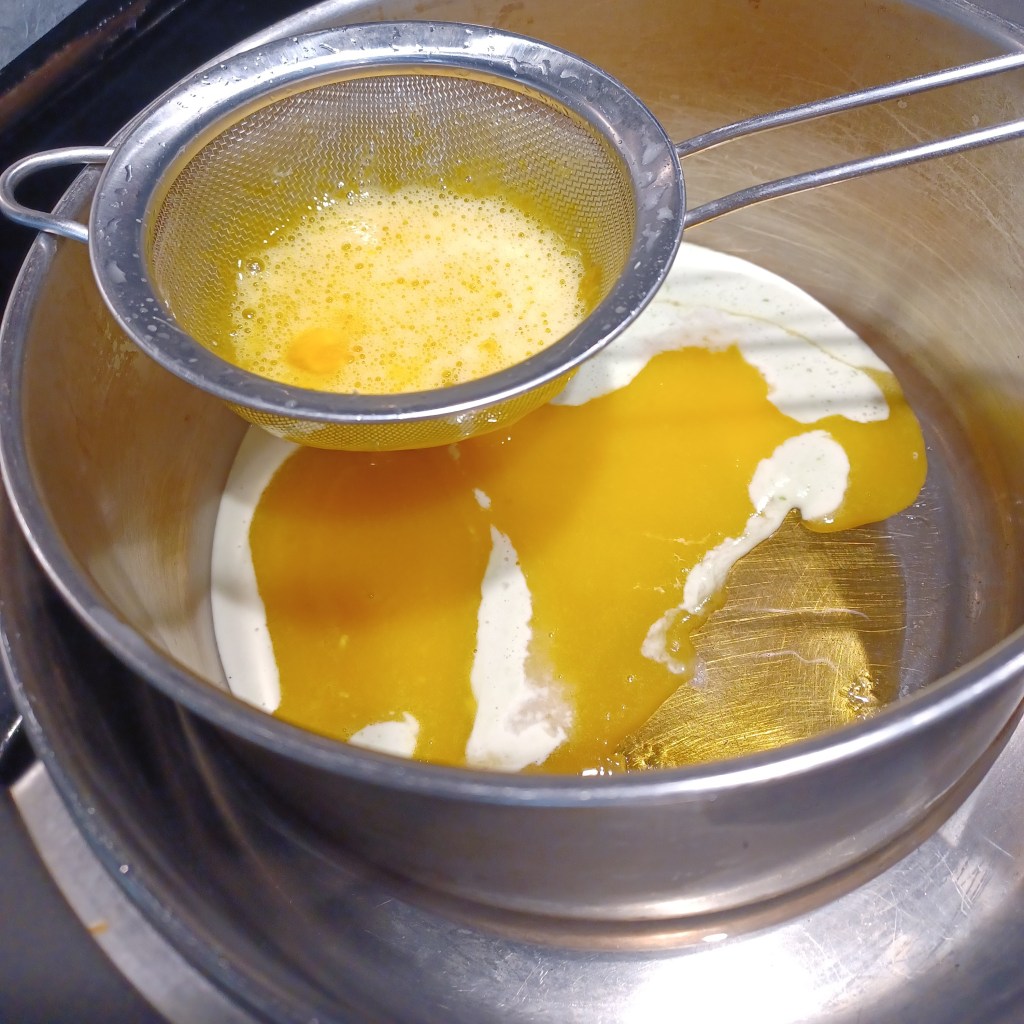
Sieve coconut cream and egg mixture: Into the caramel saucepan, use the sieve and filter the coconut cream while pressing the pandan leaf with a tablespoon – discard the leaf when done and rinse the sieve. Filter the egg mixture into the saucepan – stir inside the sieve with a spoon as well as scrape the bottom of the sieve. Discard any unfiltered egg.
Cook mixture: Make sure enough water comes up the outer sides of the inner saucepan to reach the level of the inside mixture – pour off excess water so the saucepan is stable, or add more water if not enough (you may use a double boiler instead of this). Place the setup on a medium-sized flame on high heat. Using the spatula, scrape the bottom and sides of the mixture pot constantly. Watch the heated water carefully, and when it starts to produce bubbles to indicate boiling, immediately turn down the flame so that barely any bubbles rise.
Continue to cook until the mixture is quite thick but not scrambled – around 10 minutes or more. The final stage is indicated by when you lift up a large amount of the mixture with the spatula, the mixture drips in blobs with a space of 1 to 3-second interval in between, depending on how thick you want it. Or the mixture is heated up to 77C or 170F. When ready, immediately remove the saucepan from the hot water. Pour cooked mixture into a bowl or a glass container (sterilized in boiling water) to cool down. When cooled down, cover and refrigerate immediately – do not cover before cooling as any condensation formed will spoil it.
Question mark symbol above vintage old book on blackboard background
Hi everyone,
I’m trying to get ideas and feedback from people who are interested in Nyonya/Peranakan food and cooking. Could you please fill out a survey form that won’t take more than 5 minutes? Your input will be invaluable in giving me ideas in which direction I should go with my writing.
I was recently interviewed by Universiti Malaya on the state of the Baba Nyonya Peranakan culture, and I shared my thoughts on its current state, the challenges, and what it could take to revive the culture.
I don’t claim to be an expert on the culture, but I shared my thoughts from years of research and writing about it.
Please watch this 2-part interview and feel free to discuss what was said. Kamsiah.
MY FIRST HARDCOVER BOOK ON THE BABA NYONYA PERANAKAN CULTURE WITH 32 NYONYA RECIPES IS NOW AVAILABLE FOR USD $35 (ORIGINAL PRICE $39) WITH FREE SHIPPING TO UNITED KINGDOM, UNITED STATES ($39), AND MELBOURNE REGION, AUSTRALIA. ADDITIONAL SHIPPING CHARGE FOR OUTSIDE THE ABOVE AREAS (S.E. ASIA INCLUDED).
It documents the History of the Baba Nyonya Peranakans and details the important Cultural Traditions and Celebrations, as I share my family stories growing up in such household.
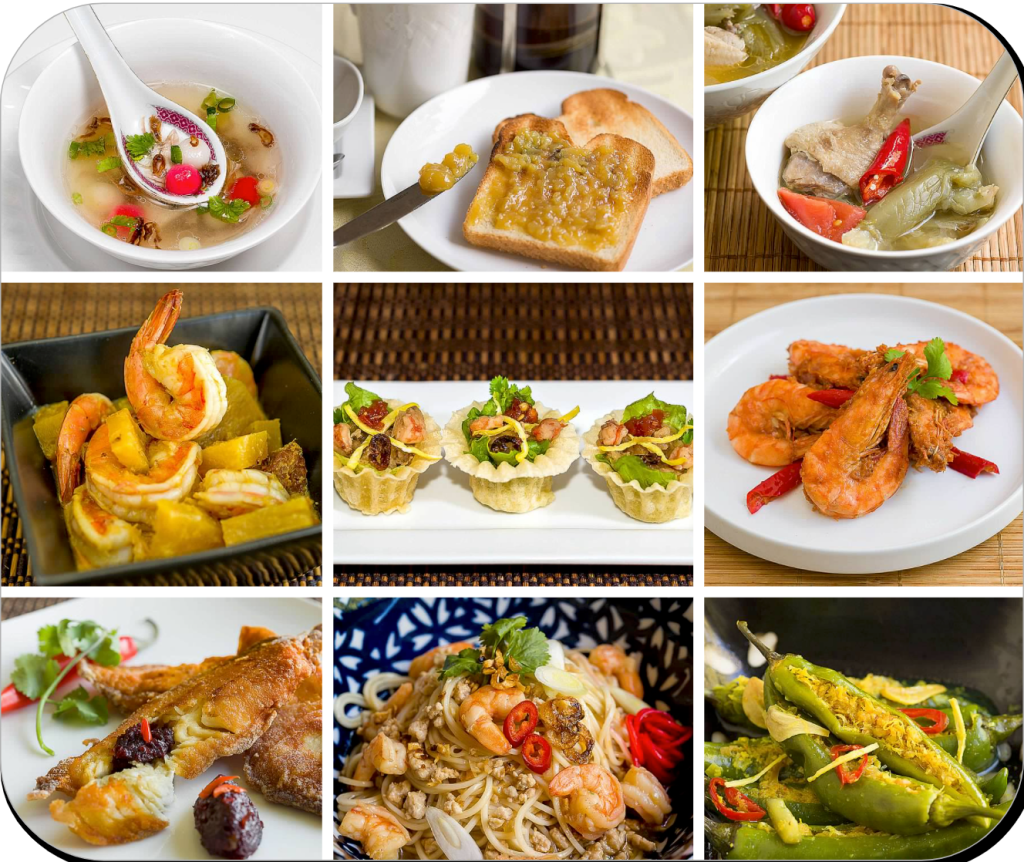
Each chapter showcases a Nyonya recipe (Poh Piah, Chap Chai, Tauhu Sumpat, Sambal Nenas Timun, Kobis Masak Lemak Puteh, Pongteh, Ayam Temprah, Asam Fish, Ikan Sambal, Udang Lemak Masak Nenas, Top Hats, Buah Keluak, Achar Chili, Itek Tim, Laksa, Mee Siam, Sri Kaya, Kueh Chang Nyonya, Kueh Ee, Pineapple Tarts, Bi Tai Bak, Kueh Angku, Kueh Bakul Goreng, Bubur Pulut Hitam, Tapeh Pulut, Bubur Cha Cha, and many more!) that my grandmothers were known for.
This beautiful book will make a great coffee table display and read, as well as serve as a document of our precious culture for many future generations.
ORDER FORM (The Baba Nyonya Peranakans Book only – hardcover)
ORDER FORM (The Baba Nyonya Peranakans Book only – hardcover)
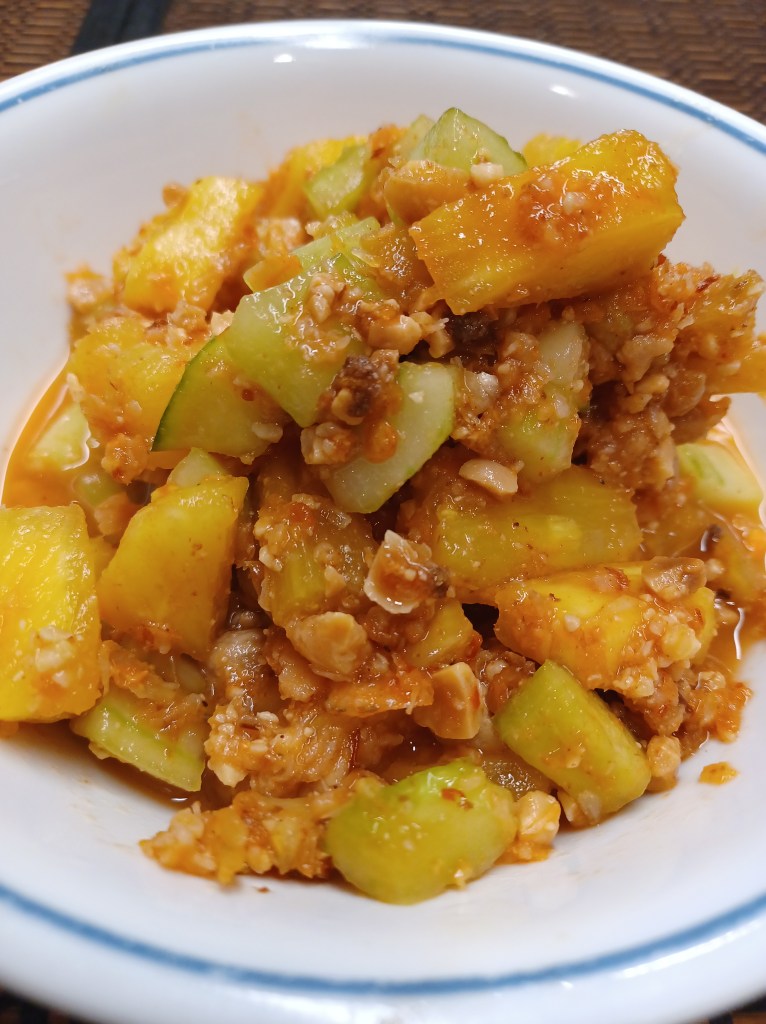
More than a week ago, I gave a cooking demonstration on Zoom of two classic Nyonya dishes, Udang Lemak Masak Nenas and Sambal Nenas Timun (photos of the finished dishes below). I am including the whole demonstration for you to watch how to cook these wonderful dishes, and also for you to get to know me as a cook. Enjoy! (Recipes from The Baba Nyonya Peranakans book)
Udang Lemak Masak NenasSambal Nenas Timun
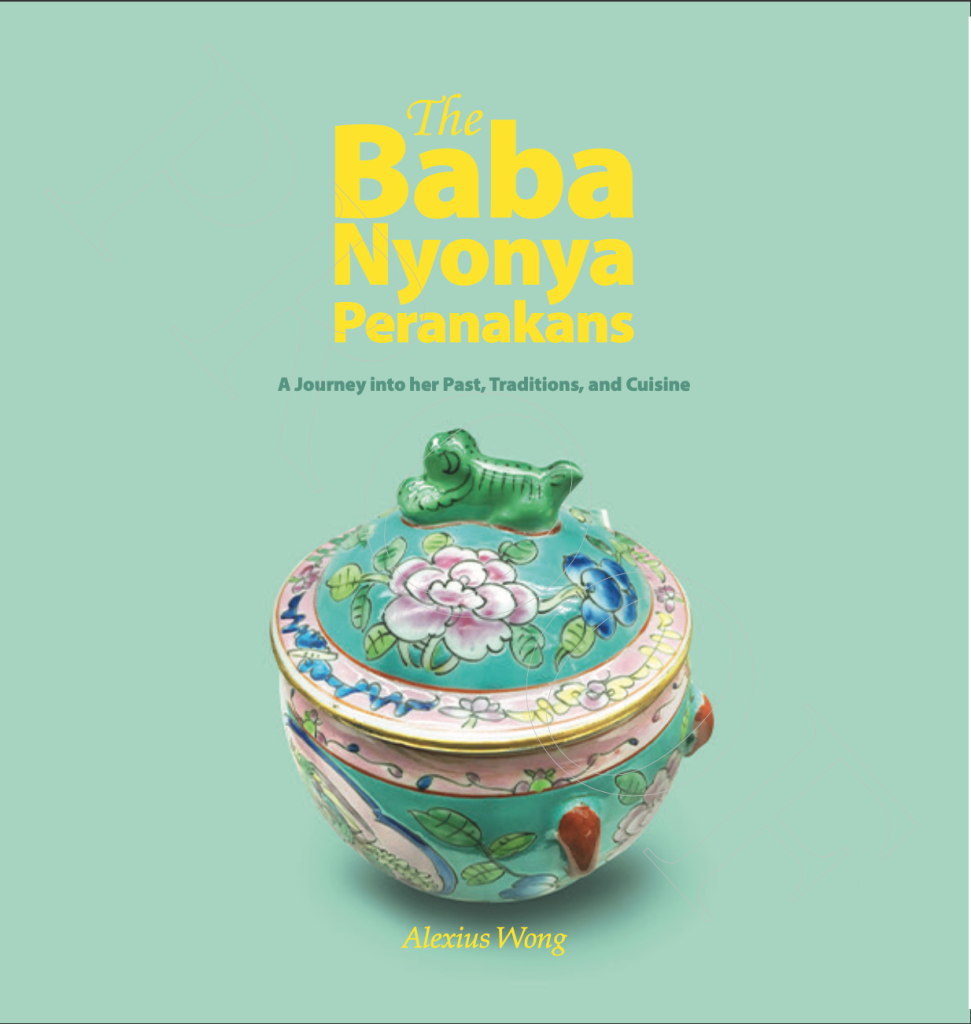
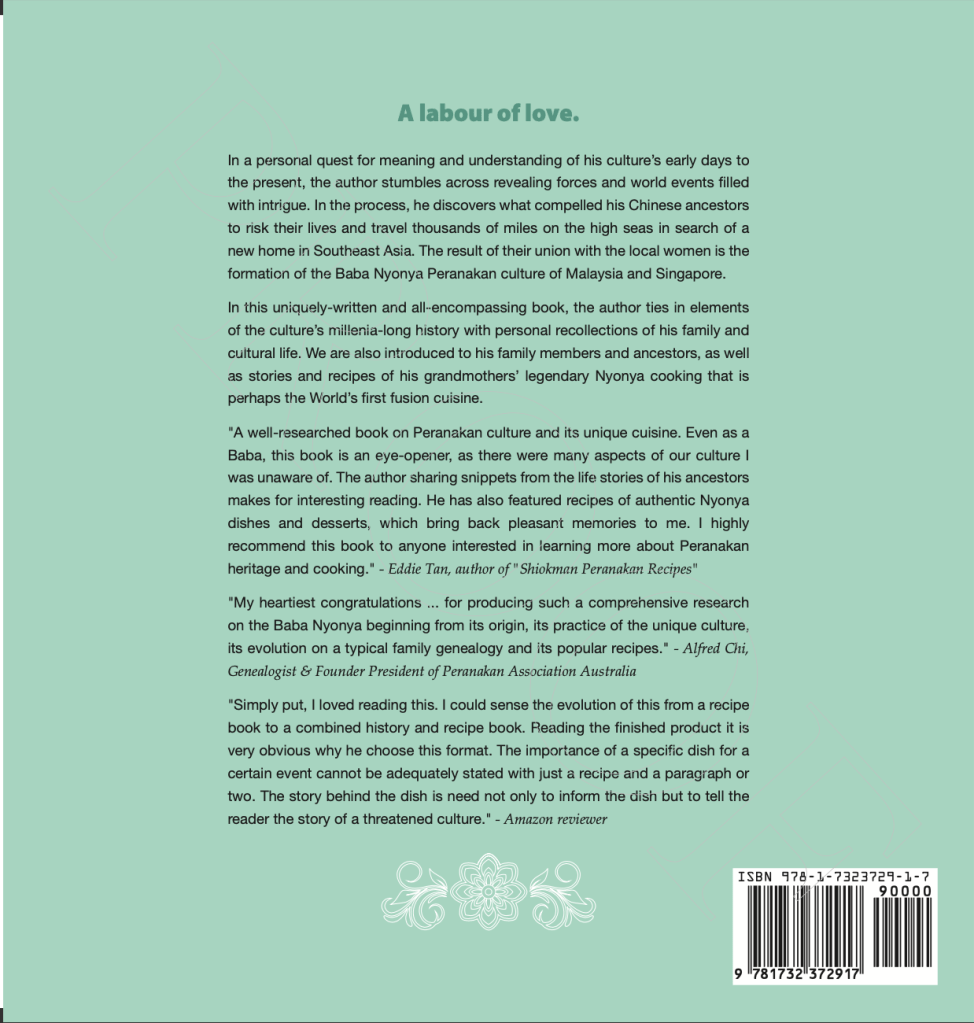
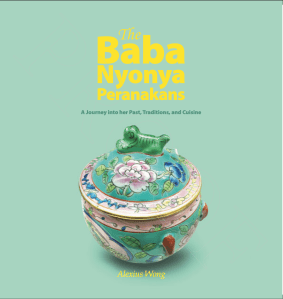
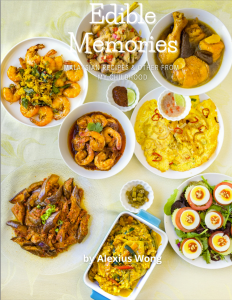
The hardcopy and e-book of The Baba Nyonya Peranakans book (1st image) and Edible Memories e-cookbook (2nd image) are available – more information on the Homepage.
Throughout my years of researching and writing Nyonya recipes, this cookie has been extremely elusive and the most difficult for many reasons. My grandmothers never made these cookies when I was young, contrary to what many think of the superwoman Nyonya cook – I only recall them coming home with plastic containers filled with these bright white morsels and tasking the grandchildren to place red dots with toothpicks dipped in red dye. However, my father recalls seeing his mother make it during his youth with a covered kuali/wok over woodfire. Furthermore, I came across recipes that either were not successful or required sago flour that is impossible to find outside of Malaysia. So, in a way, I was either afraid of trying again or I had just thrown in the towel, literally!
However, my love for these sweet treats did not diminish with time, and my recollections of them were always the fondest and warmest memories of my grandmothers whipping up a culinary storm in the weeks of preparation for the Lunar New Year. Recently, I came across some recipes in Nyonya food groups on Facebook, and I noticed that the cookies were made with only tapioca flour which is easily available – this stirred up my curiosity and interest in it again. Besides, the beautiful wooden cookie moulds given by my sister years ago were gathering dust and beckoning me to give it another try. So I printed out a few versions and I studied them before I made a couple of batches. Below is my version of it.
Making Kueh Bangkit is deceptively tricky. The baking or frying of the flour with pandan leaves is to infuse it with the leaves’ aroma as well as to dry the flour out to produce a mouth-melting product. The use of the egg yolk with hardly any egg white attached is to avoid the stiffening protein from the white, and it is beaten with the sugar to lighten its yellow color – get store-bought and not farm eggs so that the dough will stay quite white. The dough has to be formed with just the right amount of coconut cream, not the milk, so that it is not only rich in flavor, but the cookie is flaky and soft due to the lack of excess water. The baking has to be at the right temperature and timing so that it is cooked but without the slightest browning. And finally, it has to be cooled down for a day so that the inside moisture distributes evenly throughout the cookie before it is consumed. In other words, lots of attention and precision must be given to the whole process, just like any wonderful complicated pastry.
When I showed the results of my cooking online in a group for expats in the USA, a lady remarked that there were so many good cooks and bakers in the group. I replied that necessity is the mother of invention, and so is nostalgia. I hope you are able to produce a successful bunch with my recipe and envelope yourself with fond memories of this cookie and growing up eating it.
I have provided an alternative it you do not possess a Kueh Bangkit mould.
Note: I tried another batch today using the baked flour straight out of the oven and once cooled down, and the end product had no noticeable difference compared to those made with 2-day old baked flour, as recommended by many Nyonya and recipes. I also made cookies with a 1¼-inch/3-cm cutter, and the recommended cooking time was fine.
Printable Copy (link) – Recipe from Edible Memories e-cookbook
60 grams/2.1 oz confectioners/icing sugar or caster sugar (very fine)
1 egg yolk, making sure as little egg white is attached
2 cans (400 ml each) coconut milk, the creamiest kind, or 800 ml fresh coconut milk
⅛ teaspoon regular salt
Red food coloring
Toothpick
Tools:
Baking or Parchment paper, not wax paper (optional)
Baking tray, large
Pastry brush, small (optional)
Kueh Bangkit mould or 1¼-inch/3-cm cookie cutters
Step 1 (can be made in advance): Turn the oven on to 300F/ 150C with the rack in the middle shelf. Pour the flour into a baking container or aluminium foil shaped like a bowl on a tray (for easy cooling later). Wipe the pandan leaves clean, cut into 2-inch/ 5-cm pieces, and hide them in the flour with equal spacing. Place flour into the oven and bake for 1 hour 30 minutes.
Alternative: fry this in a dry wok on medium-low heat for at least 45 minutes, stirring very gently (or the flour will fly everywhere) until the pandan leaves are dry and slightly brown.
Meanwhile, place the coconut milk into the coldest part of the fridge.
Step 2: Once baked, remove the flour from the oven. If it is to be used immediately, remove the foil onto a plate or pour the flour onto a cooler pan. Remove the pandan leaves carefully trying not to break the dried leaves. Allow to cool for around 30 minutes or more to room temperature. If reserving for another time, cover it with some plastic film once cooled. Sift the flour to measure 200 grams in a bowl, and the rest into a smaller bowl (around 2 tablespoons worth) – be careful not to pass pieces of dried pandan leaf through it.
Step 3: Remove the fresh coconut milk or 1 can from the fridge – the cream should have solidified slightly on the surface. Gently scoop the cream, while avoiding the separated water, to measure 100 grams worth – open the other can if more is needed. Add the salt and stir well. Set aside. Return the rest to the fridge to be chilled if more is needed.
Step 4: In a mixing bowl, add the sugar, and make a well in the middle. In the middle, add 3 tablespoons coconut cream and the egg yolk. Using a large whisk or hand mixer, gently beat this mixture for around 3 minutes until the yolk is pale in color and the mixture is completely smooth and it does not feel granular to touch (to make sure that the sugar is completely dissolved especially if using caster sugar).
Step 5: (will take around 30 minutes): Add the flour in 3-tablespoons increments to the sugar-egg mixture and mix well using a spatula. Add more flour until the mixture is quite stiff. At this point, add 1 tablespoon coconut cream and mix with the spatula, breaking up the dough. Add more flour and mix with your hands as you rub the dough pieces with your fingers. Continue adding the cream until 50% of it is used and all the flour has been added. You should have a very dry crumbly mixture.
Continue to add the coconut cream by ½-tablespoon increments by dripping it evenly over the dough. Use your fingers to break the larger dough pieces when mixing it. Continue to add the cream (not all used) until the dough barely comes together when gathering a handful into a ball – it should still crumble when pressure is applied. Cover with plastic film or moist kitchen towel.
Step 6: Turn the oven on to 300F/ 150C with the rack in the middle shelf. Place a baking/parchment paper big enough on a large baking tray – optional.
Step 7: Using a small pastry brush, dip it in the reserved excess flour and dust the mold indentations well. Shake off any excess but do not tap it on the countertop. Grab a small palmful of dough and squeeze hard to make it come together. Push the dough into the mold pattern making sure that it covers the whole indentation by pushing the dough quite firmly and evenly, with excess over the sides and mould top level (the dough should be a bit crumbly and fall apart easily – don’t panic).
When all the patterns in the mould are filled this way, use a butter knife to slide down the mould to shave off any excess. Turn the mould over and tap out the cookies on one end of the tray – you may have to turn the mould on the other end to tap out some stubborn ones. Repeat the process by dusting the moulds first. Arrange the cookies on the tray and use the brush to brush aside any fine bits of dough in between the cookies to a corner – remove with a spoon. If the dough is sticking to the mould, use a skewer or toothpick to clean the indentations before making the next batch of cookies.
Alternative: Roll or press down with hand on dough in small batches into ½-inch/ 1-cm thickness – if it is too crumbly, add a bit more coconut cream until it holds together more. Use the cookie cutters to cut the dough and transfer to the tray. Or you can push the original recipe dough into the cutter sitting on the tray to the above thickness.
Step 8: When the oven is hot enough, place the cookies in the middle rack with equal spacing from the oven walls. Set the timer to 15 minutes. At the halfway mark, rotate the pan so that the back of the tray is now in the front. The cookies should be colorless and as white as possible.
Step 10: After 15 minutes, turn the oven off and leave the cookies to cool down completely inside the oven. When cool, remove from the oven. Using the red food dye, dip the broader end of the toothpick into the dye and place a dot on the cookie, preferably the eye or the center.
Once cooled, place them in a storage container but do not close the lid tight for a day. They are best eaten the following day and after.
The hardcopy and e-book of The Baba Nyonya Peranakans book (1st image) and Edible Memories e-cookbook (2nd image) are available – more information on the Homepage.
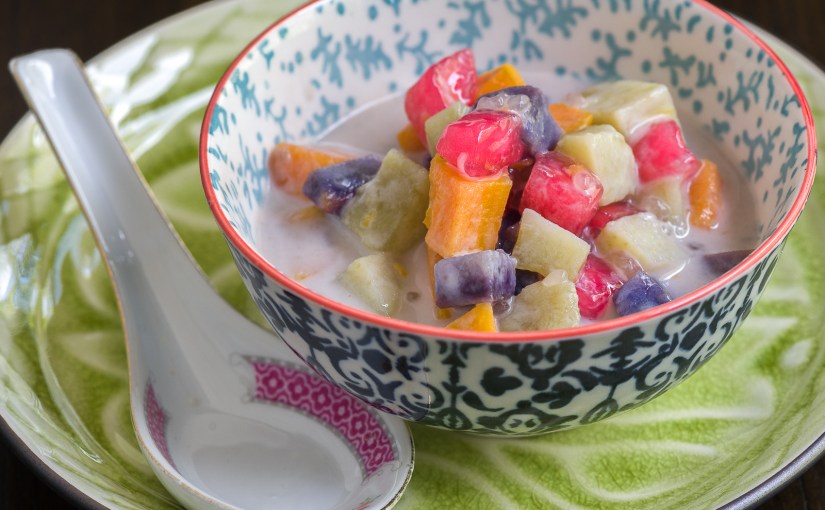
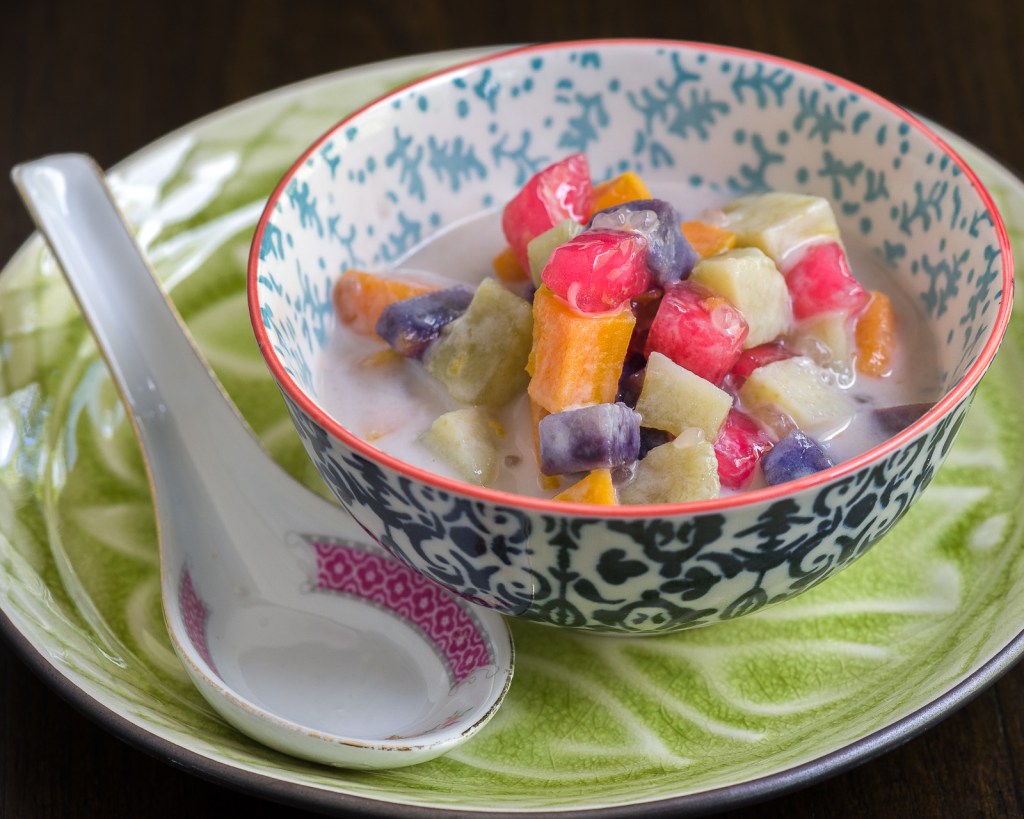
In making this dessert, we see the use of starches other than the usual rice: purple yam, sweet potato, and taro root—common Southeast Asian tubers. The velvetiness of the cooked root starches matches the rich, thick, and sweet broth with tiny sago pearls and bits of chewy cooked tapioca gluten swimming in it. The list of ingredients is typically found in Nyonya desserts: rich coconut milk, caramel-like gula melaka (palm sugar), and fragrant pandan leaf. This sweet soup can be served warm or cold, hence its consumption by my family at any time of the day or night.
Traditionally, this dish was a simple preparation of the tubers and chewy uncolored tapioca gluten bits. Nowadays, the dish has been modified with the chewy bits stained red, green, blue or yellow, which makes the dessert visually more appealing. When dealing with the sticky tapioca dough, make sure to wet your hands and the knife; this ingredient adds a chewy textural element to the dish reminding one of gummy bears. The original recipe only uses the tapioca flour gluten instead of the sago/tapioca pearls—you may choose which one to include, or maybe even both, a common choice these days. Since canned coconut milk comes in different consistencies and qualities, I have made the necessary adjustments.
This is a fairly rich dish, so it is usually served in small portions in the diminutive colorful Peranakan bowls described in the above reading. As no surprise, I would find my family members sneaking into the refrigerator in the middle of the night to have an additional serving. Once you make and savor this rich flavorful dish, you may find yourself doing the same and perhaps bursting into a spontaneous Cha Cha dance, from which this dessert takes its name!
Recipe from The Baba Nyonya Peranakans book
8 servings
Preparation time: 1 hour
½ taro root, peeled and cut into 1-centimeter (½-inch) cubes, or 1 medium (250 grams or ½ pound) Asian purple sweet yam (Malay: keledek)
1 medium (250 grams or ½ pound) Asian yellow sweet yam (Malay: keledek), peeled and cut into 1-centimeter (½-inch) cubes, or 1 sweet potato
3 pandan leaves
2 cups (475 ml) fresh or canned regular coconut milk, or 1½ cups (350 ml) canned thick coconut milk plus ½ cup water
½ teaspoon salt
100 grams or 3½ ounces gula melaka (palm sugar), or ½ cup light brown sugar
3 tablespoons water
50 grams (1¾ ounces) sago or tapioca pearls, around 2 mm diameter
50 grams (1¾ ounces) tapioca flour — optional
Food coloring (any color) — optional
Place the taro root and yam (or sweet potato) cubes on a steaming plate. Place 2 pandan leaves in the steaming water and steam the roots for 15 minutes or more until completely cooked or just fork-tender.
In a saucepan, simmer the coconut milk with the salt, uncovered, for 5 minutes until slightly thickened. Set aside.
In a separate saucepan, mix the gula melaka with the water, add 1 pandan leaf (tied into a knot), and bring it to a brief boil. Set aside to cool with pandan leaf in it.
In a fine-mesh sieve, wash the sago pearls well until the water is clear, then drain it well. In a pot, boil the sago in plenty of water for 5 minutes or until the center is transparent and cooked. Strain into a fine sieve, drain, and set aside.
To make the tapioca gluten (optional): In a saucepan, bring ¼ cup of water to a boil. Pour all the boiling water in one go onto the tapioca flour in a bowl, add a few drops of the food coloring, and mix well until a thick dough forms. Fill a saucepan with lots of water, and bring it to a boil. Meanwhile, turn the dough mixture onto a small cutting board. With wet hands, shape the dough into a thin roll. Dip the tip of the knife in a bowl of water, and cut the dough at a diagonal to get 1-centimeter- (½-inch-) wide small square or triangular pieces. Once the water is boiling, place the pieces into the boiling water. The pieces are done when they are translucent and begin to float, 1 to 2 minutes. Remove and keep in a bowl of cold water. Drain well before mixing with rest of ingredients.
In a large bowl, mix all the ingredients together with the coconut milk and syrup (without pandan leaf). Serve warm or chilled.
The hardcopy and e-book of The Baba Nyonya Peranakans book (1st image) and Edible Memories e-cookbook (2nd image) are available – more information on the Homepage.
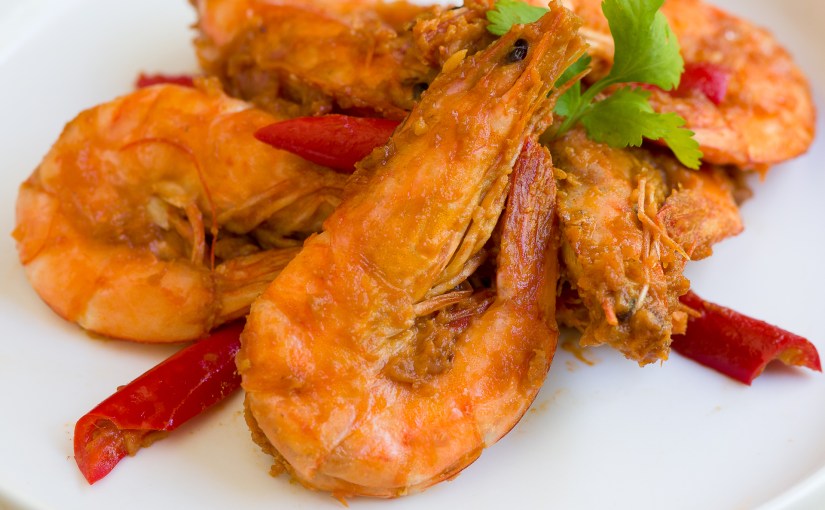
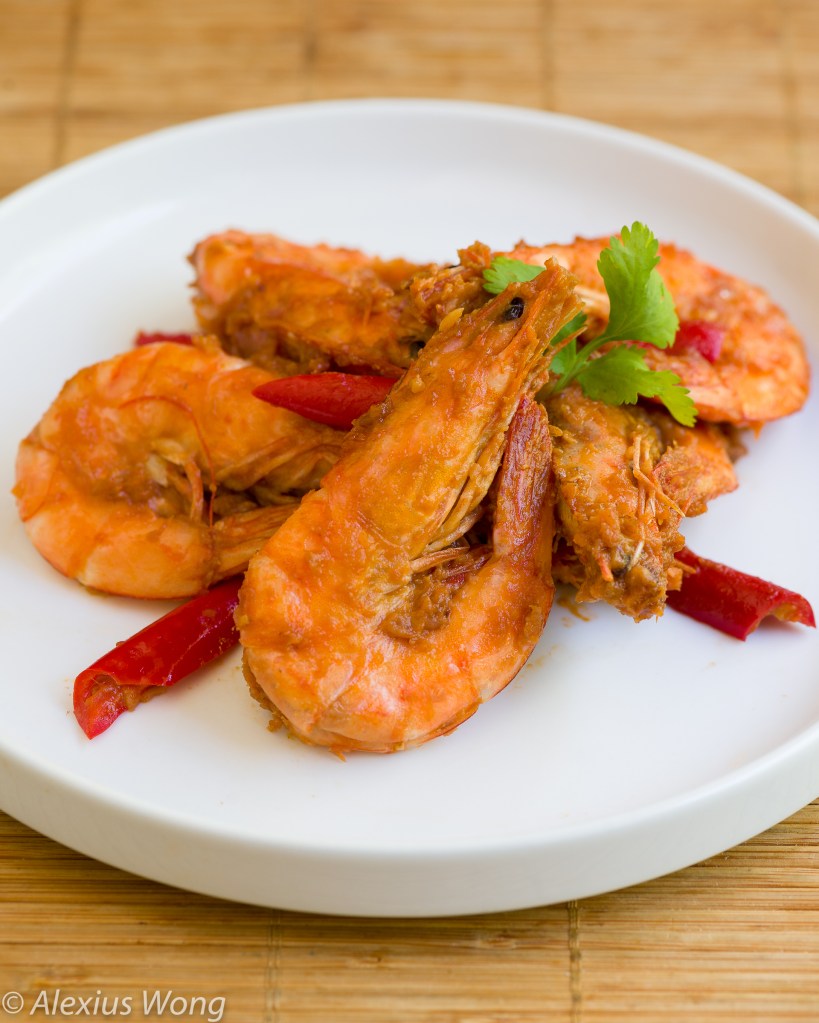
In this recipe, we see the Peranakan’s penchant for using a strong flavor element with a mild ingredient – tamarind. The use of this acidic and slightly sweet fruit perhaps harkens back to its introduction by the Tamils who controlled the Straits of Melaka in the 11th century. This application is not only found in this shrimp dish but also in another made with pork belly.
The basic Nyonya version of this dish is very simple, comprising of only shrimp and tamarind paste as the main ingredients. However, this version is a “supped up” recipe that I learned from Tri Suherni, who worked as my parents’ cook for many years. Here, she brings her Javanese background with the addition of garlic, shallots, chilies, and whole peppercorns into the whole flavor profile.
The shells are kept on the seafood for two purposes. First is to keep the shrimp moist during the cooking, and second, to act as a canvas for the tamarind sauce to hold on to. The deveining process allows the tamarind to permeate the flesh during marination.
The best way to really enjoy this dish is the following. Holding the shrimp by its tail, bite the head off, and savor the sauce while you bite down to release the slightly bitter head juices. After removing the shell from the mouth, bite off a chunk, savor the sauce as you manipulate the shell off the flesh – the deveining facilitates this easy removal. Scoop a spoonful of rice into the mouth and chew the mixture together. After completely working on a shrimp, don’t forget to lick the remaining sauce on the fingers. There is no finer way to enjoy it, which, to me, is totally delightful for this gourmand.
Recipe from Edible Memories e-cookbook
Serves 4
Marination time: 1 to 2 hours
Preparation and cooking time: 15 minutes
500 grams (1 lb) medium-large to large shrimp, unpeeled and deveined
2 tablespoon unseeded tamarind pulp, mixed well with ½ cup room-temperature water and strained
5 whole white peppercorns
2 cloves garlic, peeled and chopped roughly
5 small/50 grams shallots, peeled and chopped roughly
4 tablespoons vegetable oil
2 red chili peppers, stemmed, seeded, and cut into half lengthwise and into 1-inch pieces
Salt
Sugar
If shrimps are not deveined, follow these steps:
Holding the shrimp in one hand, hold a small serrated knife on other hand, and start at the top of the first shell after the head. Cut into the shell and into the flesh all the way until before the last segment before the tail, deep enough to expose the vein – do not go deeper than the vein. Remove the vein and dip it with the fingers in a bowl of water to release it.
Snip off the end of the shrimp nose and the antennae with a pair of scissors or a knife. Add the shrimp to a large bowl, and drain the shrimp very well of water. Add the tamarind paste, and mix well. Marinate for 1 to 2 hours in the refrigerator.
When the marinated shrimps are ready:
In a food processor, add the peppercorns and crush into fine bits but not into a fine powder. Add the garlic and shallots, and process into a fine paste. Remove and reserve.
In a pan on medium-high heat, add the oil. Add the processed mixture and fry for 2 minutes until aromatic. Add the marinated shrimp and tamarind mixture, and add ½ teaspoon sugar and ½ teaspoon salt, or to taste. Cook each side of shrimp for 2 minutes only. Add the chilies and stir for 2 minutes until the sauce is completely dry. Serve immediately.
The hardcopy and e-book of The Baba Nyonya Peranakans book (1st image) and Edible Memories e-cookbook (2nd image) are available – more information on the Homepage.
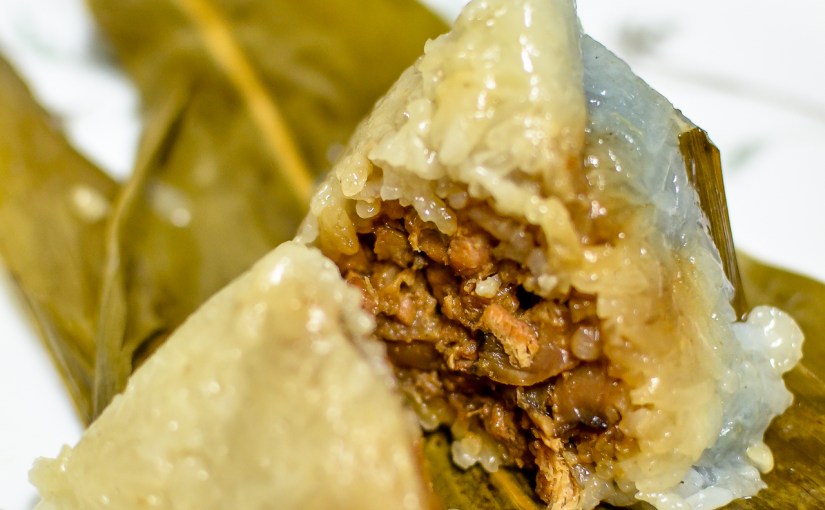
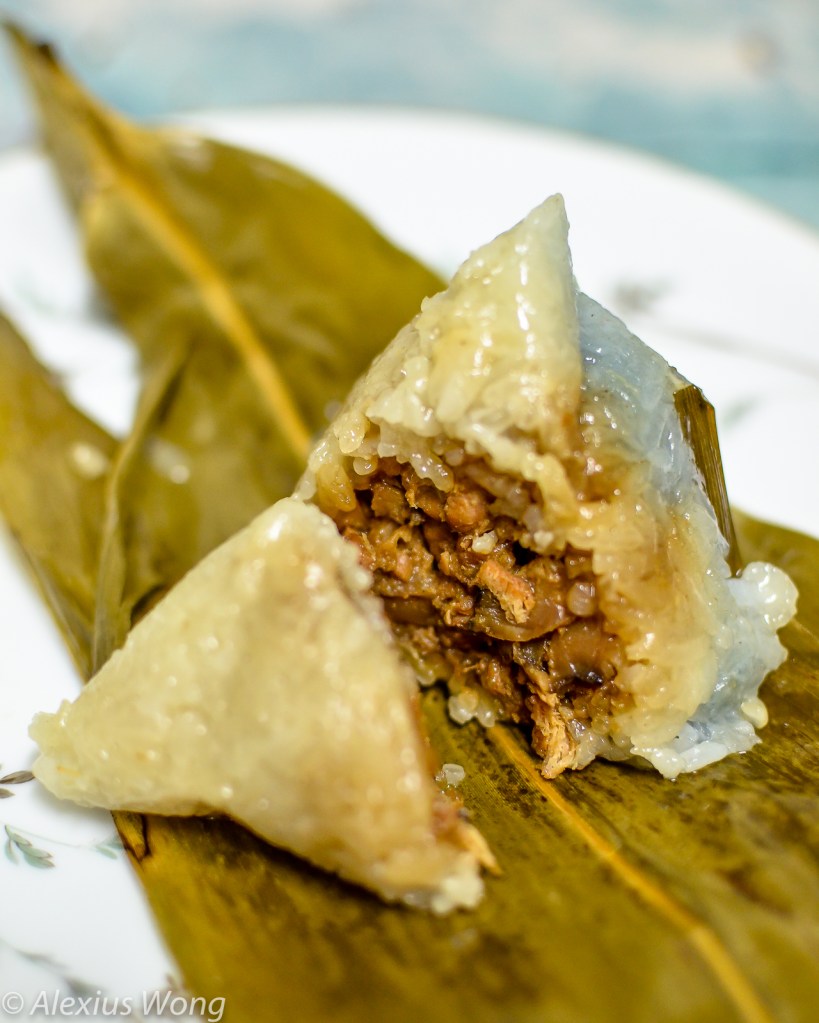
The Summer Festival is celebrated on the fifth day of the fifth month (the “double fifth”) of the lunar calendar (7th June this year). It is also known as the Kueh Chang festival, which is closely associated with the Dragon Boat Race Festival. In preparation for this special day, Nyonya ladies would get together and spend time making kueh chang dumplings, consisting of glutinous rice and usually with a stuffing in the middle, all wrapped in bamboo leaves from China (they are larger and preferable to the local Southeast Asian leaves). In some Peranakan communities, savory meat dumplings known as kiam bak chang are popular. However, in the Malacca Peranakan community, sweet meat dumplings known as kueh chang melaka are made instead, along with kueh chang abu that are made with an alkaline solution and paired with a choice of either sweet coconut jam (sri kaya) or palm sugar syrup (gula melaka) to temper the dumpling’s slightly bitter taste.
On the day itself, the dumplings are given to relatives and friends in remembrance of the Dragon Boat Festival. This celebration has its roots in an ancient belief of the Wu and Yue people of eastern and southern China who believed that river dragons controlled the water needed for agriculture. These dragons were fed such offerings in an attempt to control the rainfall necessary for the crops. In time, the festival was associated with another legend in which the poet, Chu Yuan, drowned himself in 277 BCE to protest a prince’s refusal to consider social reform suggested by the poet. Rice dumplings were taken by the rescuers as sustenance while they searched for the drowned poet. Legend has it that to keep the river dragons from feeding on the poet’s body, carved dragonheads were displayed at the helms of the boats, and dumplings were thrown into the river to distract the sea creatures. According to local belief, the dragons, upon ingesting the offerings, then instructed the local people to wrap the dumplings in leaves. This custom is now practiced to represent the qualities of family unity and loyalty, the same ones that Chu Yuan exemplified in his patriotic endeavors.
As a child, I would sit next to Mamah and watch her make this once-a-year kueh chang, mesmerized by her wrapping the various ingredients in leaves. It was astounding to watch the precision that she displayed in the folding of the bamboo leaves into perfectly formed cones, the addition of the right proportion of soaked glutinous rice and meat-mushroom stuffing into the leaf cones, and the deftness of her fingers as she produced tightly sealed, perfectly symmetrical pyramid-like dumplings in a couple of decisive and well-honed hand movements (video). After she shaped the dumplings, my stomach would growl as I impatiently waited to taste my favorite dumpling that was served only once a year for this celebration.
For the anticipation-filled grandchildren, all that mattered was the 2-hour wait while these dumplings were boiled, pulled out, and served piping hot. We used to dive into our plates without any sense of decorum. When this treat was “in season,” I mostly enjoyed them in the morning after they were warmed up in the steamer. As an adult living away from my homeland, I missed partaking in this annual ceremony. With that in mind, my auntie Madam Dolly Lee would freeze a bunch for me so I could enjoy them when I returned to Malaysia months later to visit her and my family. This dumpling truly brings back fond memories of my deceased relatives; even writing about this stirs up a deep yearning within me for these dumplings and their warm familial presence. To satisfy my year-long wait, I would eat them to my heart’s content for breakfast and tea for the next few days.
In the recipe, I have provided an easy alternative for those who, like me, are not deft enough with the bamboo leaves, which produces the same result as the traditional wrapping and cooking method. If you are wrapping the dumplings, make sure to use the leaves from China as they tend to be longer and more appropriate for wrapping.
To this day I have not perfected this elusive skill of dumpling making, despite breaking the folding process down into a science. I guess innate intuition and time-honed culinary skills cannot be easily replaced by book smarts.
Dried bamboo leaves, from China, washed and soaked in water, and striped into 2 long pieces along the spine (optional)
To make the filling
If using whole coriander seeds, toast in a dry pan on medium heat – do not allow to burn by continuously shaking the pan. When they are fragrant, remove seeds to cool down. Crush seeds until a fine powder.
In a pan on medium-high heat, heat the oil and fry the garlic for 1 minute until slightly golden brown. Add the bean sauce and stir well for 1 minute. Add the mushrooms and stir for 2 minutes. Add the pork, melon sugar, and coriander and stir well. Add the water, salt, and dark soy sauce.
Cover the pan with a lid, lower the heat to medium low, and bring the filling to a simmer. Remove the lid and cook until the mixture is quite dry, about 10 minutes. There should be barely any moisture left. Remove and let cool.
To make the rice
In a pan on medium-high heat, heat the oil and stir-fry the garlic for 1 minute until golden brown. Add the rice, salt, and white pepper. Lower the heat to low and stir the rice for 10 minutes until the mixture is quite dry, but not too dry.
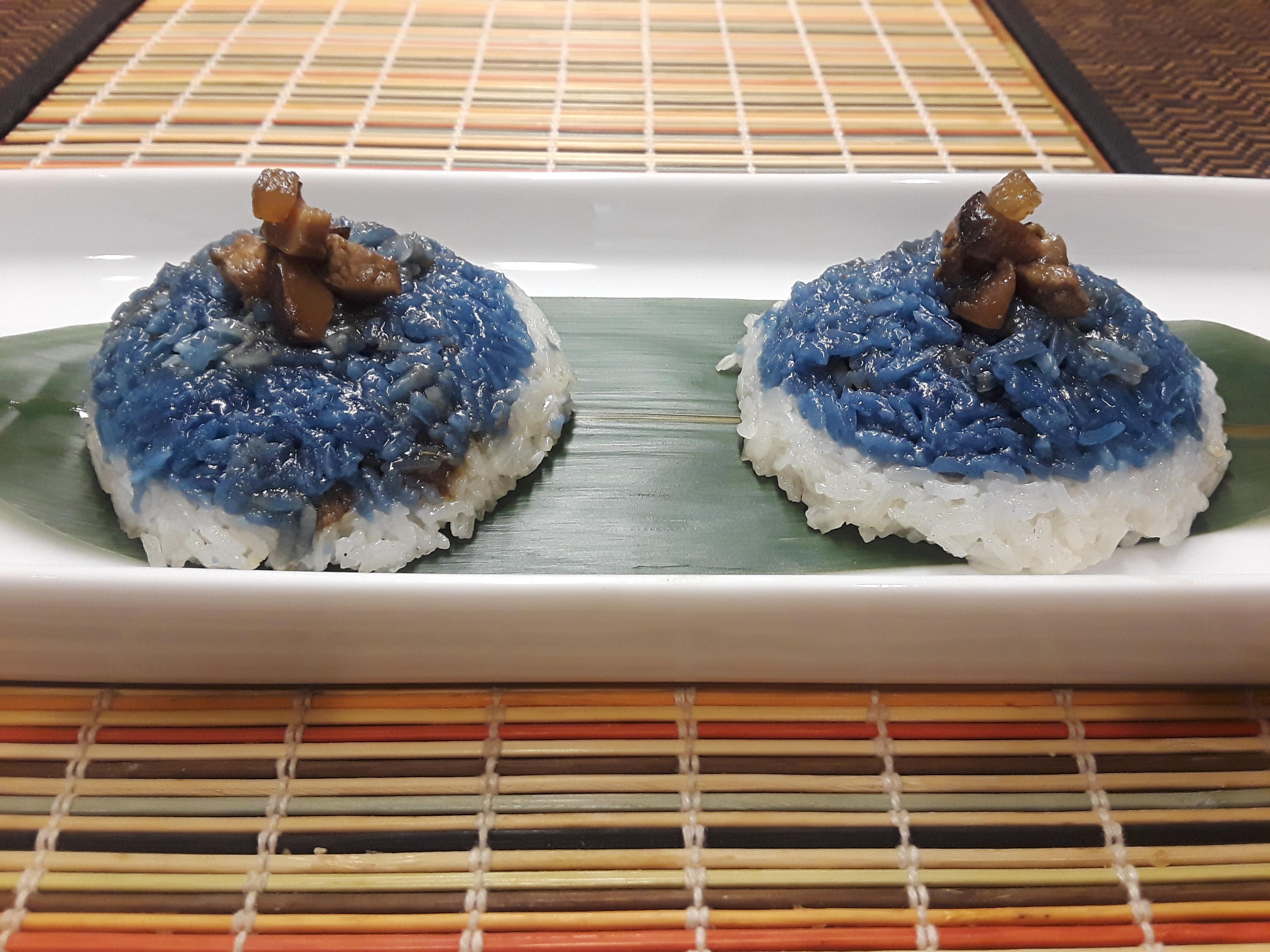
Remove and divide the rice mixture into thirds. Stain one-third with enough bunga telang water to make an even deep color but slightly translucent blue-stained rice (about ½ teaspoon coloring to a tablespoon rice) – use more coloring if necessary.
To assemble and cook the dumplings in bowls:
You can make a medium-size rice dumpling in small rice ceramic bowls. Place the unstained glutinous rice in a wide container like a pie dish. Pour 3 cups of water onto the rice, add the pandan leaves bundle to the simmering water, and steam on medium heat for 20 minutes (you may place bamboo leaves on the bottom of the dish and on top, shiny side touching rice, to add fragrance to the dumpling). After 20 minutes, add another 1 cup of water and steam for another 20 minutes. Remove and cover with plastic wrap.
If cooking a lesser quantity of cooked rice than what the recipe calls for, cover bottom of bowl with strips of bamboo leaf cut to size in a cross fashion with shiny side up, and add three times the amount of water to rice by measuring with the same spoon or ladle, or 2 tablespoons rice plus 6 tablespoons water per rice bowl. Steam until completely absorbed (15 to 20 minutes). Remove bowls, scoop out rice, and cover cooked rice with plastic wrap. Save the bamboo leave strips.
Into empty (or the same) rice bowls, place back the strips of the bamboo leaves, shiny side up, and add 1 tablespoon of blue-stained rice and 2 ½ tablespoons of water. Steam for 15 minutes.
Remove the bowls from the steamer. Make a slight indentation in the rice, add 1 heaping tablespoon of meat filling, and cover the mixture with 3½ tablespoons of cooked unstained rice, or the initial amount steamed in the bowl. Press down the top surface firmly and evenly with the backside of a spoon, and steam for 15 minutes. Remove and cover with plastic wrap while they cool down. Press down the top firmly to compact the dumpling. Refrigerate any unconsumed portions in the bowls.
To serve, loosen the rice from the side of the bowl with a tablespoon or butter knife before inverting it onto a plate.
To reheat unconsumed portions, steam the uncovered bowls for 15 minutes on medium-low heat.
You can also wrap the dumpling the traditional way with soaked Chinese bamboo leaves (instructions link). Tips for folding the dumpling is at the bottom of this posting.
Here is a video of the bowl technique:
The hardcopy and e-book of The Baba Nyonya Peranakans book (1st image) and Edible Memories e-cookbook (2nd image) are available – more information on the Homepage.
Tips for folding the bamboo leaves:
– the width of the bamboo leaves is ideally between 4.5 to 5 cms, or wider and not less.
– when putting the 2 leaves together, the shinier side (or side facing the sun) is on the top so that it is the inside of the package, and it has a slight antistick quality for easy unfolding without the dumpling breaking apart.
– try to find a close match of both leaves, length and widthwise. If there is no match, place the shorter or the lesser width one on the top which will end up as the inside wrap. The leaves must face the opposite directions with each other (a leaf tip on top of the other’s branch). With the lesser width leaf, match both leaves on the side closer to you so as to create a strong lip when closing the dumpling with the flap.
– the initial folding on the cone is made at the 1/3 way point on the leaf side. I initially started at the 1/2 way point but there was not enough leaf flap to create a secure seal. Once I adjusted it, all was fine.
– when adding the first bit of rice at the bottom of the cone, a deep indentation has to be made in it so as to allow an even distribution of meat stuffing in the corner, or, if not, the bite there will be pure rice.
– when adding the stuffing, it is added generously to create a mound, not flat, and away from the side leaves. This ensures that the dumpling has the right rice-to-filling ratio, and the dark stuffing would not be showing on the exterior when cooked.
– when adding the rice to the filling, it is added around the filling first. This ensures that the filling is protected by the surrounding rice, and the flavors are not diluted in the boiling process.
– before closing the dumpling, the backside of rice touching the leaf flap is pressed down to lower it slightly. I can’t explain why my grandmother did this.
– after folding and closing with the leaf flap, the excess is turned towards the side where the initial cone makes a small flap located at the bottom of the cone running up on one side. This way, when tying the dumpling, the wrapping string will wrap both the cone flap and excess leaf flap at the same time to produce a secure package.
– when wrapping the string a couple of times around the chang, the loose end is passed next to the string attached to the pole but on the side closer to the cone top tip to ensure that the wrapping stays in place and doesn’t slip down, which will create a loosely wrapped dumpling.
– the traditional seagrass string is the best as if you tie it too tight or hard, it will snap. It allows the correct tension as well as a bit of give for expansion when boiling. Using yarn or plastic string only leads to tying too tight or too much tension, creating a “tali pinggang” effect in the final product.
– the excess leaf flap and string have to be cut off for a prettier bundle.
– when boiling, at midpoint, the bottom ones have to come to the top. Extra boiling water is used to top it off when the water level becomes lower than the top chang.







 Baba Nyonya Peranakans